

Unlocking Cell-Type-Specific Genetic Insights with Google DeepMind’s AlphaGenome 2
Explore how Google DeepMind's AlphaGenome 2 advances the prediction of variant effects at the cell-type level, transforming genomics research with improved accuracy and single-cell resolution.
On this page
Introduction
Understanding how genetic variants impact gene expression and cellular function across diverse cell types has long been a challenge in genomics. The heterogeneity within tissues means that the effect of a DNA variant can differ substantially based on the specific cell type and state involved. To address this complexity, Google DeepMind has released AlphaGenome 2, an advanced AI-driven DNA sequence model designed to predict variant effects in a cell-type-specific manner. This breakthrough represents a significant leap beyond prior models by incorporating rich, single-cell data conditionings that sharpen predictions for individual cells rather than averaging effects across bulk tissue.
What Is AlphaGenome 2?
AlphaGenome 2 is a state-of-the-art sequence-to-function deep learning model developed by DeepMind that inputs a 1-megabase (1 Mb)-long DNA sequence along with a computational representation of a target cell’s state. This cell-state embedding conditions the model’s predictions, allowing it to estimate how specific genetic variants influence molecular features such as RNA expression, chromatin accessibility, histone modifications, transcription factor binding, and even CpG methylation in that particular cell type.
Unlike its predecessor, AlphaGenome 1, which averaged variant effects across multiple bulk tissues, AlphaGenome 2 uniquely tailors its predictions to individual cell states. This is made possible by integrating vast single-cell RNA sequencing (scRNA-seq) and assay data from thousands of studies, enabling the model to resolve very closely related cell types and dynamically adapt to unseen cellular conditions without requiring retraining or fine-tuning.
Key Technical Features
- Input: A 1 Mb window of human or mouse DNA sequence.
- Cell Conditioning: A 256-dimensional embedding derived from raw scRNA-seq counts or similar cell-state data.
- Architecture: A deep U-Net style model including a convolutional encoder, an 11-block transformer, and a decoder that utilizes FiLM layers to modulate activations based on cell-type embeddings.
This sophisticated architecture allows AlphaGenome 2 to generate condition-specific predictions, enabling researchers to study variant effects at unprecedented resolution.
Training and Model Refinement
AlphaGenome 2 was trained through a multi-stage process:
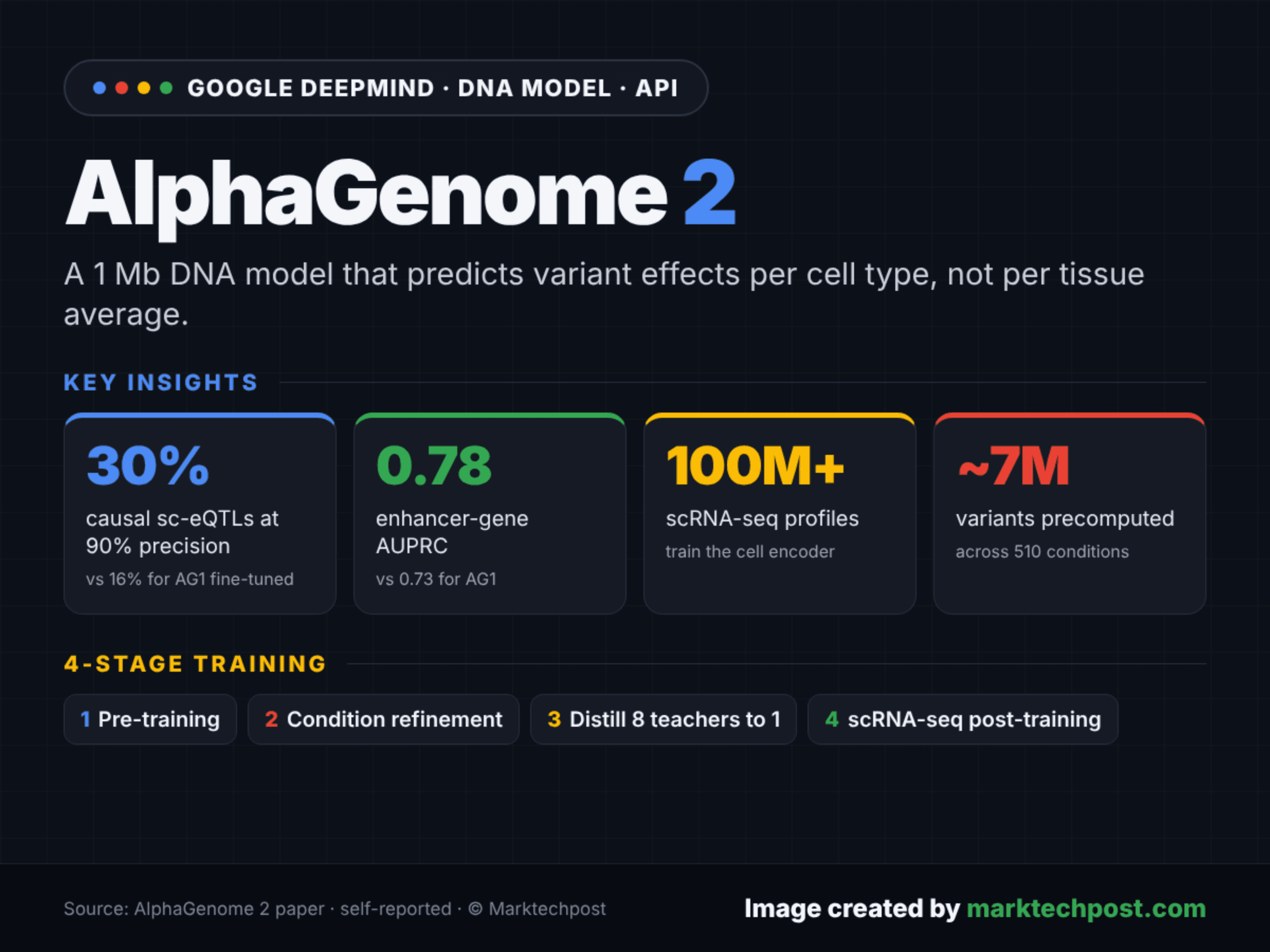
- Pre-training on a large corpus of bulk tissue and detailed single-cell RNA and ATAC pseudobulk data covering nearly 4,000 tracks from 36 studies.
- Condition refinement, which involved tuning only the FiLM layers and embeddings to better capture cell-specific functionality.
- Teacher-student distillation, compressing eight large teacher models into a smaller, more efficient student model using experiments with mutated DNA sequences.
- Post-training embedding alignment, mapping an independently trained single-cell expression encoder (based on over 100 million human scRNA-seq profiles from datasets like CELLxGENE) into the fixed AlphaGenome 2 model’s cell-state space.
This process enables users to input raw single-cell counts from up to 256 cells to define new or unseen cell states without re-training the main model, a major advantage for exploratory genomics.
Performance Benchmarking
AlphaGenome 2 substantially outperforms its predecessor and competing models across multiple critical benchmarks:
Single-Cell eQTL Analysis
Using the TenK10K dataset covering 28 immune cell types, AlphaGenome 2 achieved a recall of 30% for causal variants at 90% precision, nearly doubling AlphaGenome 1 fine-tuned’s 16%. Additionally, the direction-of-effect recall increased from 23% to 43%, reflecting a better understanding of whether variants upregulate or downregulate gene expression.
Enhancer-Gene Interaction Prediction
On held-out ENCODE CRISPR interference (CRISPRi) data, which includes enhancer-gene regulatory links, AlphaGenome 2 scored an area under precision-recall curve (AUPRC) of 0.78. This surpassed AlphaGenome 1’s 0.73 and an ensemble of Borzoi models at 0.61, with notable gains for enhancers located far (100–2,500 kb) from target genes.
Imputation Across Epigenomic Tracks
When tested on 181 held-out epigenomic tracks for assay imputation, AlphaGenome 2 outperformed the baseline Avocado model on 166 tracks, demonstrating its broad generalizability.
Rare Disease Cohort Application
In an unseen Parkinson’s disease cohort, AlphaGenome 2 reached 41% recall versus 17% for Scooby, a recent competing model, indicating robust performance even in complex clinical contexts.
Comparison with Other DNA Sequence Models
| Feature | AlphaGenome 2 | AlphaGenome 1 | Borzoi | Scooby |
|---|---|---|---|---|
| Input DNA length | 1 Mb | 1 Mb | 524 kb | 524 kb |
| Cell-state conditioning | Single-cell embeddings | Fixed multitask tracks | Fixed multitask tracks | Cell-embedding decoder |
| Multi-condition prediction | One condition per call | Multiple tracks in parallel | Not cell-specific | Dataset-specific |
| Prediction types | RNA, CAGE, splicing, chromatin, histone, TF binding, methylation | Limited subset | Limited subset | scRNA, scATAC |
| Availability | Hosted API, non-commercial | Hosted API | Open source (MIT) | NVIDIA GPU |
This table highlights AlphaGenome 2’s innovation in conditioning on a rich, high-dimensional embedding representing real single-cell states, enabling finer-grained variant effect predictions inaccessible to prior models.
Developer Access and Usage
Currently, AlphaGenome 2 is accessible through DeepMind’s hosted API, primarily for non-commercial research. The API accepts raw single-cell RNA-seq counts, generating the cell-state embedding internally. Researchers can submit data from up to 256 cells per call, facilitating analysis of new or unique cell states without needing model retraining or fine-tuning.
DeepMind additionally provides:
- Precomputed variant effect atlases scoring approximately 7 million common and GWAS variants across 510 cell-type conditions.
- An atlas mapping enhancer-gene regulatory links across 640 primary cell conditions.
- Python packages (alphagenome.models.v2) and Colab tutorials to streamline integration into research workflows.
Weights for the full model will be released upon final publication, and commercial use is currently limited to private previews.
The Big Picture: Implications for Genomics and Medicine
AlphaGenome 2 introduces a paradigm shift by integrating single-cell resolution into variant effect prediction, addressing a critical bottleneck in functional genomics. This capability unlocks several important advances:
- Precision medicine: By providing variant effect predictions tailored to specific cell types, AlphaGenome 2 supports better identification of disease mechanisms localized to particular cell populations.
- Functional interpretation of GWAS hits: With precomputed scores across numerous cell types, it enables researchers to pinpoint relevant cell states for disease-associated variants.
- Drug development: Enhanced understanding of tissue- and cell-specific regulatory networks may reveal new therapeutic targets and biomarkers.
- Basic science: Researchers gain a tool to probe how genetic variation influences transcriptional and epigenetic programs within heterogeneous cellular environments.
As single-cell technologies continue to expand, tools like AlphaGenome 2 that leverage these rich datasets for high-resolution prediction will become indispensable in bridging genomics to biology.
Conclusion
Google DeepMind's AlphaGenome 2 establishes a new standard for predicting DNA variant effects with cell-type specificity. By conditioning on raw single-cell RNA sequencing data, integrating advanced deep learning architectures, and demonstrating superior benchmark performance, AlphaGenome 2 empowers researchers to decode the impact of genetic variation on cellular function with unprecedented accuracy.
The hosted API and extensive precomputed resources make this powerful model accessible today for non-commercial research, heralding a promising future for genomics-informed medicine and biology.
For the latest updates and access details, researchers are encouraged to consult DeepMind’s official documentation and publications.
Note: This article is based on publicly available descriptions of AlphaGenome 2 and does not include unverifiable details or extrapolations.