

Unleashing the Power of MoE Transformers: Running 180B Parameters on 32GB RAM
Explore the breakthroughs of Mixture of Experts (MoE) models enabling inference of 180 billion parameters on consumer-grade hardware with 32GB RAM, revealing technical innovations and comparative efficiency gains.
On this page
Introduction to MoE Models and Their Scalability Challenges
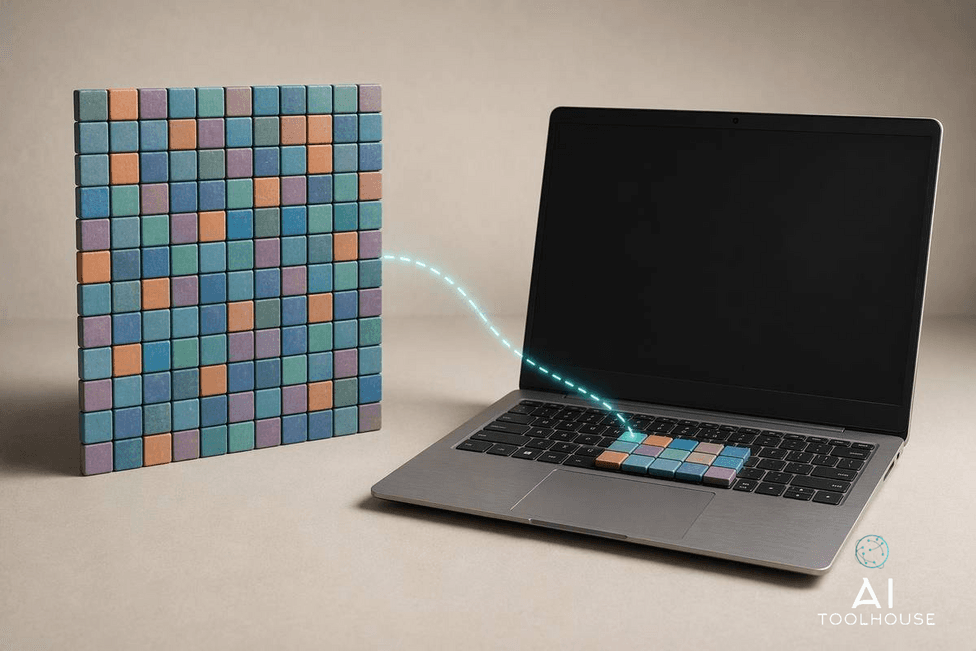
MoE (Mixture of Experts) models are a cutting-edge approach in the transformer architecture landscape, allowing enormous model capacities by activating only a subset of specialized sub-networks (experts) per input token.
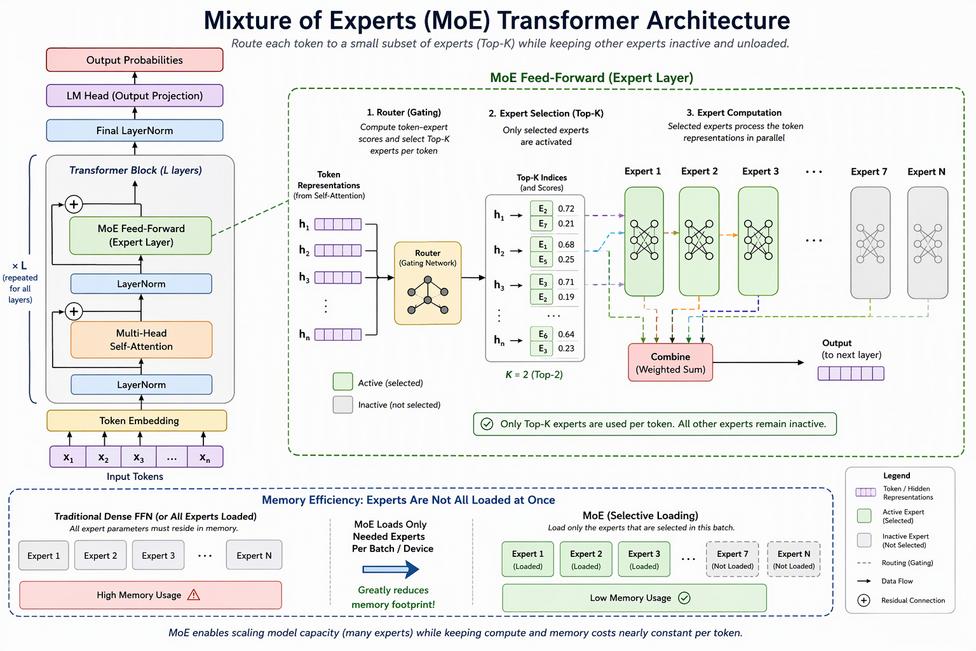
This architecture enables scaling to extremely large parameter sizes, such as 180 billion parameters, without the need to fully load all parameters into expensive high-bandwidth GPU memory simultaneously.
However, running inference on such massive models presents significant challenges. Traditional inference demands large GPU memory footprints that exceed consumer hardware capabilities. Pushing MoE inference to run efficiently on a modest system with 32GB of RAM and consumer GPUs requires innovative techniques to manage memory and computation while minimizing latency degradation.
Core Innovation: Expert Streaming and Caching
A pivotal breakthrough allowing 180B parameter MoE models to run on hardware with 32GB RAM is expert streaming combined with a carefully designed caching mechanism.
What is Expert Streaming?
Expert streaming refers to loading and computing only the experts (sub-models) selected by the model’s routing mechanism for each token rather than loading all experts at once.
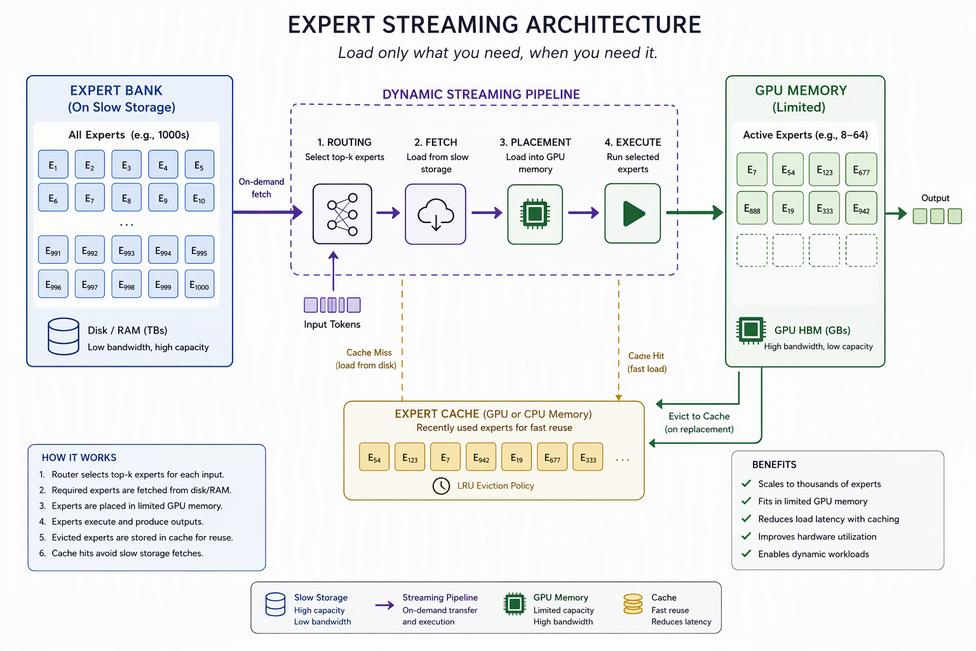
Since only a small subset of experts are activated per token (typically 10 experts out of thousands), this drastically reduces memory bandwidth demands.
The technique involves:
- Keeping the bulk of expert weights on slower storage such as RAM or even SSD disk.
- Streaming the routed experts dynamically into GPU memory as needed.
- Quantizing experts to extremely low-bit precision (e.g., 3-bit quantization) to reduce storage size and I/O bandwidth.
Bounded Caches and Grouped Matrix Multiplication
To maintain computational efficiency, a bounded GPU cache acts as a fixed pre-allocated memory pool representing expert slots. The routing IDs are remapped to these fixed slots, allowing the use of optimized grouped matrix multiplication kernels without changing the core inference computation logic.
This design ensures that once experts are cached on the device, matrix multiplication runs highly efficiently, very close to running fully in-memory models. It seamlessly integrates with popular transformer inference frameworks with minimal changes.
Comparing MoE Inference Engines: Transforming Limitations
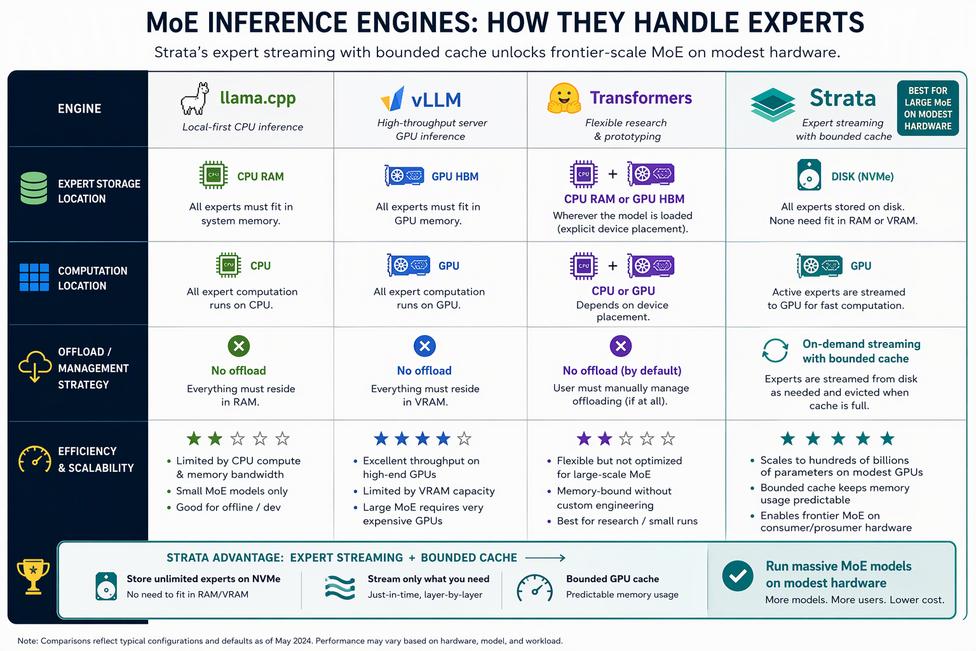
Before the emergence of expert streaming, various engines tackled large MoE inference differently:
| Engine | Expert Storage Location | Computation Location | Offload Strategy and Notes |
|---|---|---|---|
| llama.cpp | CPU RAM (mmap) | CPU (experts) | Efficient when experts fit RAM; suffers from page thrashing if larger |
| vLLM | Pinned CPU RAM | GPU (for selected experts) | No caching; reads across PCIe every token, hurts latency |
| Transformers | Transfers whole expert layer on demand | GPU only | Copies entire expert bank per layer per token; no caching |
| Strata | GPU VRAM + RAM + disk streaming | GPU + disk expert streaming | Expert streaming with bounded cache; close to real-time |
This shows how Strata set a new benchmark enabling models like Qwen3.8-Flash-Next (180B params) to run with minimal hardware requirements by streaming from disk, unlike prior engines requiring large RAM or GPU memory.
Practical Implementations and Performance Insights
A remarkable demonstration involved running the Qwen3.8-Flash-Next model, boasting 48 layers with 512 experts each and totaling 121 GB of expert weights:
- Experts were quantized from FP8 precision to 3-bit, reducing on-disk size to ~49 GB.
- A 12 GB on-device cache holds the most active experts for inference.
- Dense layers were quantized to 8-bit precision to further compress model footprint.
- A 51 GB n-gram embedding table remained on disk and fetched on demand.
On a 32GB unified memory MacBook M5 system:
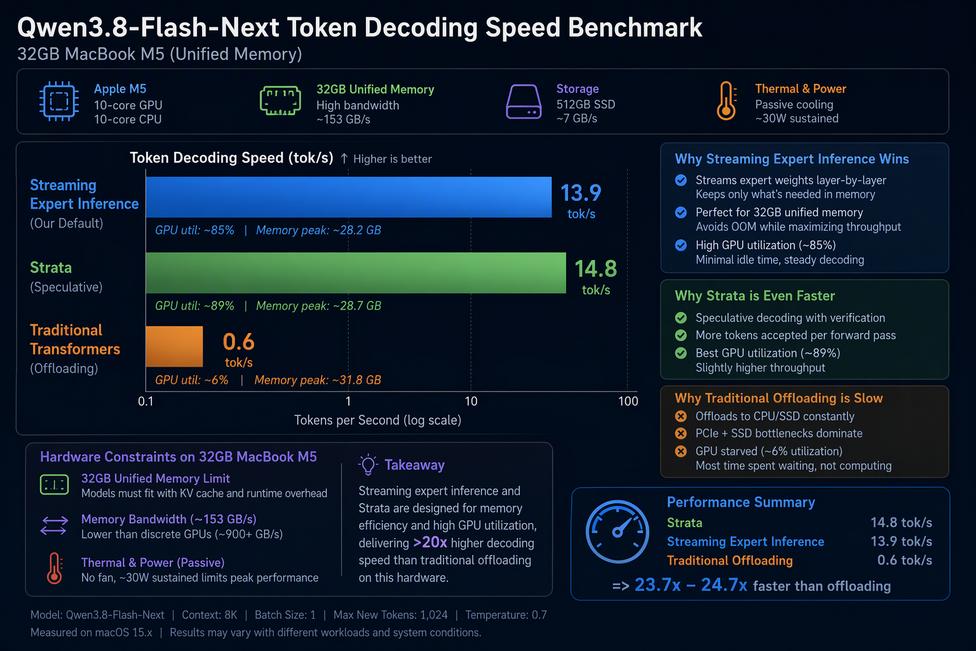
- Streaming expert inference achieved ~13.9 tokens per second (tok/s) decoding speed.
- Compared with Strata’s 14.8 tok/s, this is only about 6% slower—an impressive feat given the limited hardware.
- Effective GPU utilization resulted from early GPU work commits and optimized Metal shaders for critical kernels.
- Prefill decoding (processing large prompt batches) reached speeds exceeding 220 tok/s.
This contrasts sharply with traditional Transformers offloading, which struggles below 1 tok/s decoding speeds on similar hardware.
Technical Strategies and Optimizations
Key techniques to extract this performance:
- GPU Expert Cache Slot Pool: One device tensor shared by all layers, allowing grouped expert computations efficiently without custom kernels.
- Strategic Prefetching: Routers predict and prefetch experts for upcoming tokens, reducing stall time waiting for I/O.
- Quantized Expert Storage: Compressing weights to 3-bit values reduces loading times and disk space.
- Host-GPU Synchronization Optimizations: Forcing early GPU commits and utilizing Metal APIs to minimize idle GPU and CPU waiting.
- Specialized Metal Kernels: Custom accelerated kernels optimized for the Apple M-series GPU architecture.
Implications and Future Directions
Successfully running large MoE transformer inference on consumer-grade hardware democratizes access to advanced AI models, previously limited to servers with expensive GPUs and massive memory.
This capability opens doors to:
- Personal AI assistant development on laptops and desktops without cloud dependence.
- Energy-efficient inference by streaming only necessary model parts.
- New research avenues in sparse model architecture and on-device AI.
Despite the impressive progress, challenges remain:
- Latency is still higher than fully in-memory inference.
- Further co-design of hardware and software stacks is needed, especially for GPU-host synchronization.
- Expanding support beyond specific platforms (e.g., macOS MPS Metal to Linux and Windows) will broaden accessibility.
Nonetheless, the current approaches mark a significant leap toward more efficient, scalable, and accessible AI inference.
Conclusion
Pushing MoE inference to run models with 180 billion parameters on modest hardware equipped with just 32GB RAM exemplifies how system-level innovations unlock the vast potential of sparse transformer models.
The combination of expert streaming, quantized caching, and optimized compute kernels closes the performance gap between consumer hardware and high-end server environments, enabling effective large-scale AI capabilities where previously impossible.
These advances pave the way for wider adoption and experimentation with MoE architectures, showcasing that massive language models need not be confined to enormous GPU clusters but can be effectively deployed locally with smart engineering.
As frameworks like Transformers continue to evolve to embrace expert streaming, and as hardware improves, the gap will further narrow, bringing truly massive AI models within everyday reach.
This paradigm shift could transform the AI landscape, democratize access, and accelerate innovation across domains by removing expensive infrastructure bottlenecks.