

Revolutionizing LLM Pre-Training: The Case for No Learning Rate Decay
Explore how pre-training large language models (LLMs) without learning rate decay enhances fine-tuning efficiency, simplifies training, and presents new paradigms in AI model development.
On this page
Introduction to Learning Rate Strategies in LLM Pre-Training
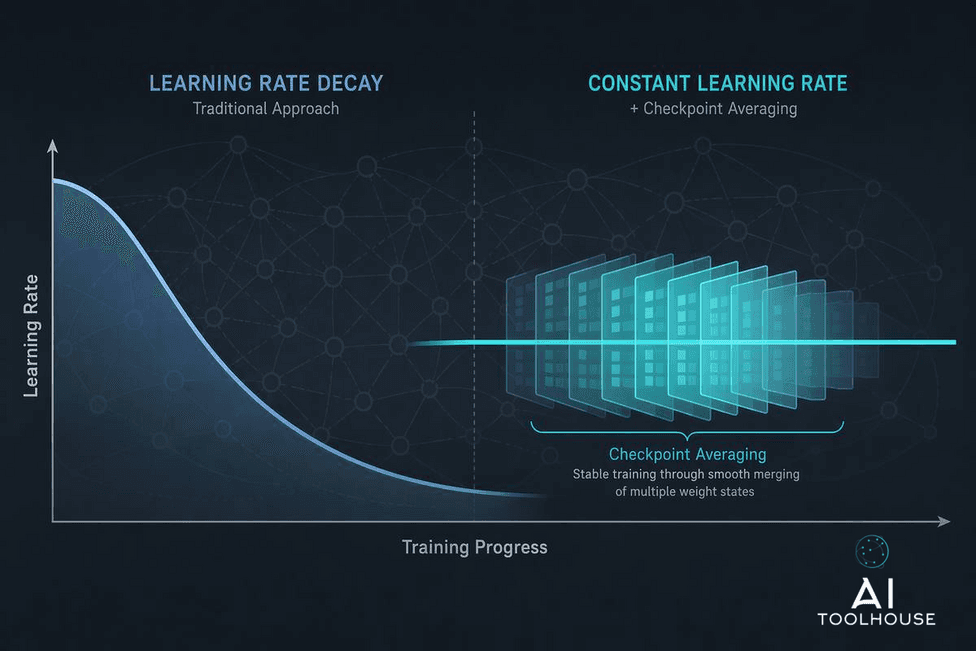
Large language models (LLMs) have transformed natural language processing by enabling a remarkable range of applications. A critical factor influencing their training efficiency and performance is the learning rate schedule. Traditional approaches mostly use learning rate decay strategies, which gradually reduce the learning rate as training progresses. However, recent advancements propose a novel approach: pre-training without learning rate decay, employing a constant learning rate accompanied by checkpoint averaging.
Traditional Learning Rate Decay in LLM Training
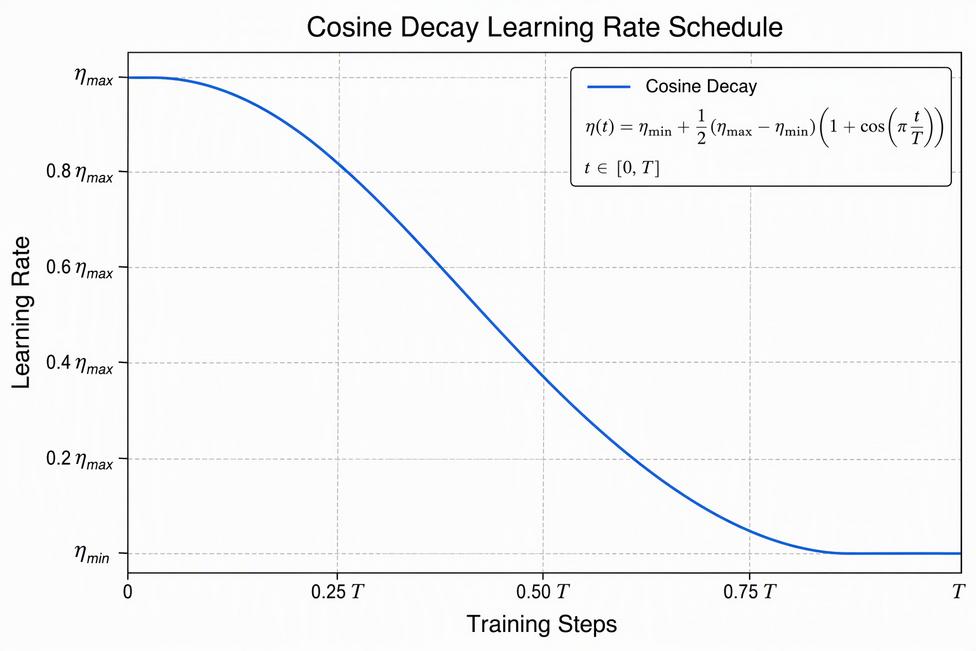
In classical LLM pre-training, learning rate decay methods like cosine decay and warmup-stable-decay are commonplace:
- Cosine Decay: Gradually lowers the learning rate to a minimal value following a cosine curve, helping stabilize training and improve convergence.
- Warmup-Stable-Decay (WSD): Initially increases the learning rate (warmup), then keeps it stable before decaying towards training completion.
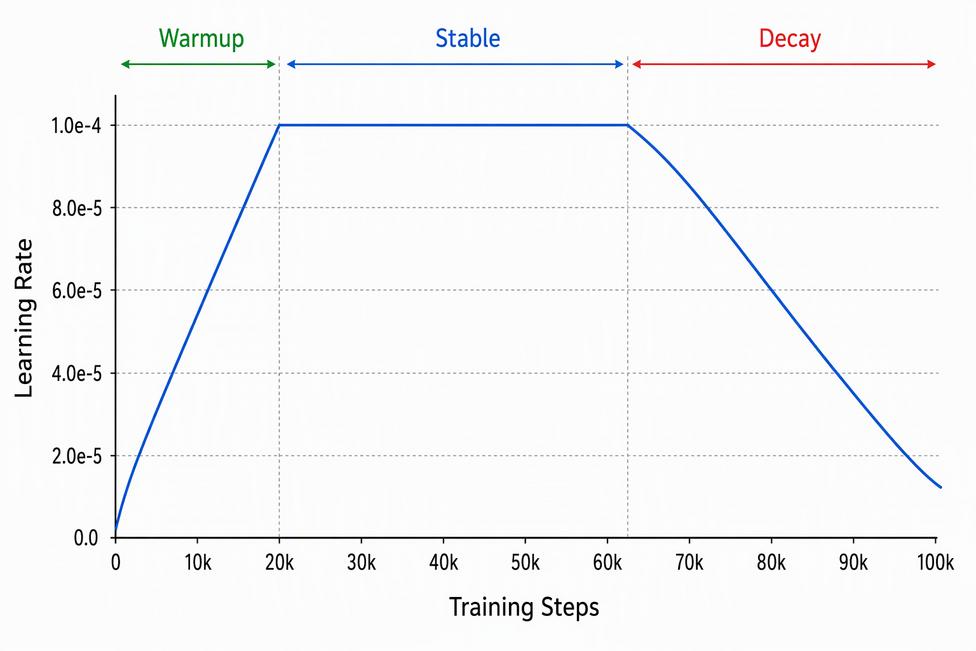
Examples like Llama 3, GLM series (4.5 and 5), and Kimi models adopt these strategies to optimize the training dynamics.
These decay schedules typically require setting a predefined total training length and tuning schedules carefully to avoid under- or overfitting.
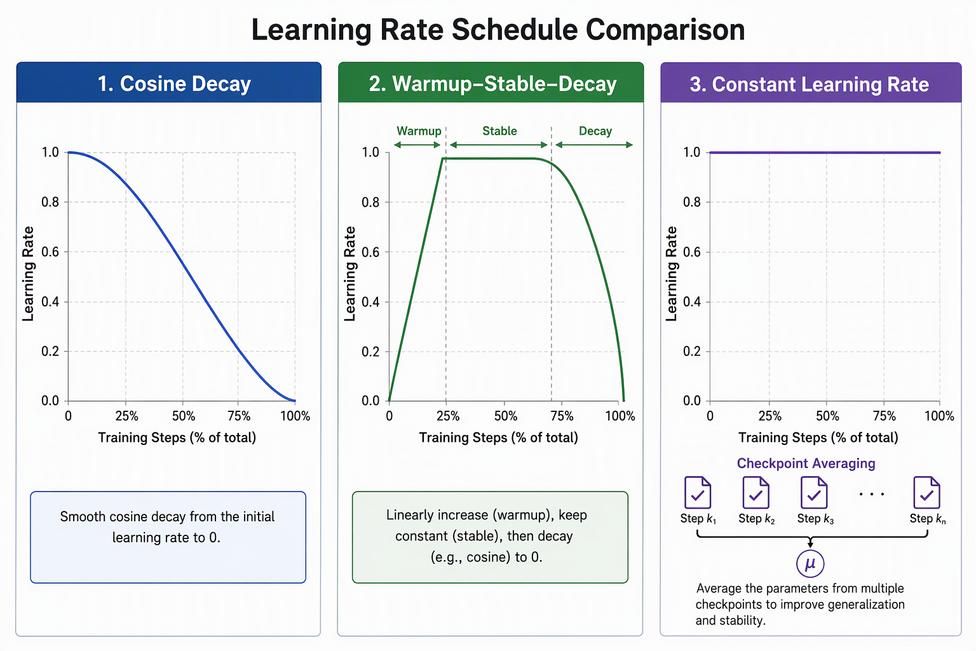
The Innovation: Pre-Training Without Learning Rate Decay
A shift is emerging favoring constant learning rates combined with checkpoint averaging or a running weight average, eliminating the decay phase altogether. This approach has been notably employed by models such as Kolibri-1 and DatologyAI's latest LLMs.
How Does This Work?
- Constant Learning Rate: The learning rate remains fixed throughout pre-training, simplifying hyperparameter tuning.
- Checkpoint Averaging: Instead of relying on a single final model checkpoint, multiple recent checkpoints are averaged. This averaging reduces the noise of fluctuations in model weights, enhancing stability and generalization.
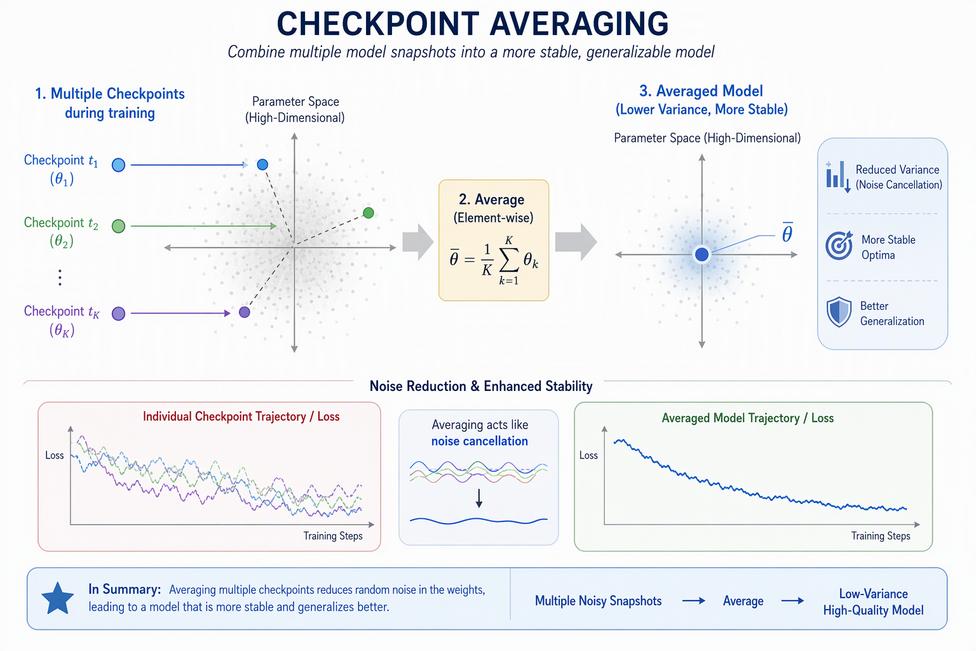
This method intriguingly allows dynamic training length decisions, as practitioners aren't bound to rigid decay schedules. Training can be flexibly halted or extended without the complications arising from a decaying learning rate.
Advantages of Avoiding Learning Rate Decay
Simplified Training Protocols
Removing learning rate decay reduces the complexity of setting detailed schedules and makes training more straightforward, particularly beneficial in large-scale distributed training settings.
Enhanced Fine-Tuning Effectiveness
Recent research suggests that pre-training without decay can enhance downstream supervised fine-tuning. It preserves the efficacy of learned representations potentially by maintaining steady optimization dynamics throughout.
Better Utilization of Training Data
Some analyses indicate that learning rate decay might prematurely reduce learning intensity, thus wasting valuable late-stage training data. A constant learning rate helps in maximizing the usage of all training data, improving model quality.
Flexibility in Training Duration
Not committing to a predetermined training length means teams can adapt based on resource availability or observed model performance, improving experimental agility.
Comparative Overview of Learning Rate Schedules
| Schedule Type | Examples | Characteristics | Practical Considerations |
|---|---|---|---|
| Cosine Decay | Llama 3, GLM-4.5/5 | Smooth reduction following cosine curve | Requires fixed training budget upfront |
| Warmup-Stable-Decay | DeepSeek series, Kimi | Increase, stable plateau, decay phases | Controlled warmup prevents instability |
| No Decay + Checkpoint Averaging | Kolibri-1, DatologyAI | Constant LR + weight averaging | Simpler to implement, flexible training |
Insights from Recent Research and Community
A study published on arXiv highlights that skipping learning rate decay in LLM pre-training can improve the effectiveness of subsequent supervised fine-tuning, which is a critical phase for real-world applications.
Discussions in the AI research community, including posts by Sebastian Raschka and contributions on platforms like ICLR, emphasize the growing adoption of decay-free schedules for their practical and performance benefits.
Alternative perspectives explore using infinite learning rate schedules or decay-free schedules through checkpoint merging, reinforcing the idea's robustness and adaptability across architectures.
Potential Challenges and Considerations
While promising, pre-training without learning rate decay may require:
- Careful validation to ensure stability since the learning rate does not decrease.
- Effective checkpoint selection and averaging strategies to fully realize benefits.
- Awareness that this approach might not uniformly outperform decay-based methods in all setups or model sizes.
Practical Recommendations for ML Engineers
- Experiment with constant learning rates combined with checkpoint averaging when training large-scale LLMs.
- Monitor training dynamics closely to judge when to average checkpoints and when to stop training.
- Compare fine-tuning outcomes against traditional decay schedules to evaluate empirical gains.
- Consider computational resource constraints; the simplified schedule may reduce overhead.
Conclusion
The paradigm of pre-training large language models without learning rate decay presents a compelling alternative to long-standing conventional methods. By leveraging a constant learning rate and checkpoint averaging, it simplifies training procedures and can enhance supervised fine-tuning results. This approach also introduces flexibility in training duration and better utilization of training data, characteristics valuable in the evolving landscape of LLM development.
As the field advances, further empirical studies and adoption across various architectures will clarify the optimal scenarios for decay-free pre-training. For researchers and engineers aiming to innovate in LLM training, exploring this method offers an opportunity to improve model robustness and training efficiency without the complexity of traditional decay schedules.