

Unlocking AI Decisions: Google's Gemini Decisions API and Gemini Decision 1 Explained
Discover how Google's Gemini Decisions API with Gemini Decision 1 revolutionizes AI decision-making by offering fast, cost-effective, multimodal scoring for developers at $0.10 per million tokens.
On this page
Introduction to Google's Gemini Decisions API
Google has recently launched an innovative API designed to enhance decision-making processes in AI applications: the Gemini Decisions API. At its core lies Gemini Decision 1, a specialized multimodal model tailored to score decision queries across multiple data types with remarkable accuracy and efficiency. Priced at $0.10 per million input tokens, the API offers developers an accessible pathway to integrate rapid and calibrated decision-making capabilities into their workflows.
This article delves into what makes the Gemini Decisions API distinct, explores its technical design, benchmarks its performance, and compares it with competing models, providing a comprehensive understanding for AI practitioners and enthusiasts alike.
What Is the Gemini Decisions API?
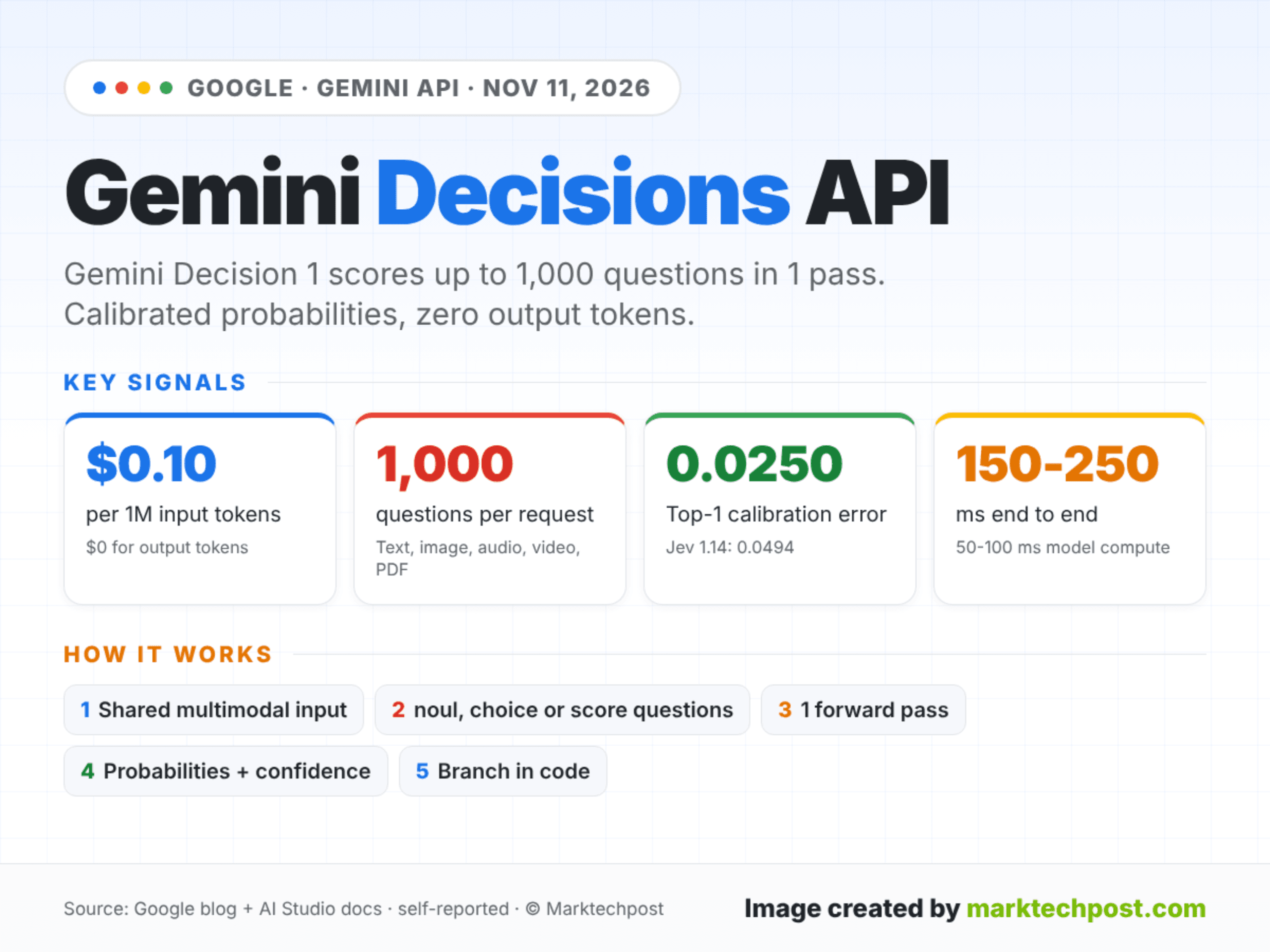
Unlike traditional language models that generate text tokens as output, the Gemini Decisions API is specifically optimized for scoring and selecting among predefined options. It ingests a "shared input"—which can be a combination of text, images, video, audio, or PDFs—and evaluates up to 1,000 decision questions in parallel against this input, returning calibrated probabilities that indicate the likelihood of various outcomes.
Each API call consists of three key components:
- Model ID: Identifies using Gemini Decision 1.
- Shared Input: A single, multimodal data input.
- Map of Questions: Defined as yes/no (noul), choice selections, or score/rubric ratings.
The output does not include generated text tokens but instead returns confidence scores for each question, enabling developers to implement branching logic, policy routing, or grading seamlessly.
Key Features of Gemini Decision 1
Multimodal Processing in One Pass
Gemini Decision 1 can interpret various input types—including text, images, audio, video, and PDFs—within a single forward pass. This multimodal capability sets it apart from many contemporaries that specialize primarily in text. By comprehensively understanding complex inputs at once, the model enables decision-making processes that span diverse data domains.
Scoring Instead of Generation
Traditional language models decode outputs token by token, but Gemini Decision 1 scores all candidate answers simultaneously. This approach results in highly efficient processing, with median compute times between 50 and 100 milliseconds, and an end-to-end latency of approximately 150 to 250 milliseconds for up to 16,000 tokens and 100 questions.
Cost Structure
Google prices the Gemini Decisions API at $0.10 per million input tokens, with no charges for output tokens since it returns probabilities rather than text. Each request is billed based on the shared input plus the question tokens, making it cost-effective for large batches of decision queries.
Calibration and Accuracy
Calibration—the alignment between predicted probabilities and actual outcomes—is a vital aspect of decision models. Gemini Decision 1 boasts a calibration error of only 0.0250, roughly half that of competitors like TypeSafe Jev 1.14, which has an error of 0.0494. This high fidelity ensures that automated decisions based on the model’s confidence levels are more reliable, essential for routing low-confidence cases to fallback systems or human review.
Performance Benchmarks
Google assessed Gemini Decision 1 across multiple benchmarks against notable rivals such as TypeSafe Jev 1.14, GPT-6 Luna (OpenAI Decisions), and Gemini 3.5 Flash-Lite. Here are some highlights from the benchmarks:
| Benchmark | Gemini Decision 1 | TypeSafe Jev 1.14 | GPT-6 Luna | Gemini 3.5 Flash-Lite |
|---|---|---|---|---|
| JevBench (accuracy) | 92.2% | 90.0% | 90.9% | 86.6% |
| Amazon ESCI (Macro-F1) | 58.7% | 56.7% | 54.7% | 47.2% |
| New Yorker Caption | 79.7% | 72.0% | 68.4% | 73.7% |
| Mind2Web Multimodal | 86.2% | 86.8% | 81.8% | 78.0% |
| PubMedQA | 79.8% | 78.2% | 74.4% | 77.6% |
| When2Call | 79.9% | 82.0% | 70.4% | 60.9% |
These results illustrate Gemini Decision 1's consistently strong performance, especially in multimodal settings and key datasets related to decision-making applications.
How Does Gemini Decisions API Compare to Competitors?
Versus TypeSafe Jev 1.14
- Input Context: Gemini Decision 1 supports a large context of 262,144 tokens shared across input and questions, while Jev 1.14 provides a similar 64K token context (extendable).
- Calibration: Gemini Decision 1's calibration error is significantly lower, reducing incorrect confidence assessments.
- Price: Jev 1.14 is less expensive at $0.042 per million tokens, compared to Gemini’s $0.10.
- Modalities: Gemini supports multiple modalities natively; Jev primarily focuses on text.
Versus GPT-6 Luna (OpenAI Decisions)
- Context Limit: GPT-6 Luna supports up to 1,050,000 tokens, nearly four times that of Gemini.
- Modalities: Both support multimodal input but GPT-6 caps question input at 400.
- Price: Both charge $0.10 per million tokens, but Gemini lacks prompt caching, which GPT-6 supports.
Versus Gemini 3.5 Flash-Lite
- Gemini Decision 1 is significantly more accurate, with its benchmark results surpassing Flash-Lite and costing less over the benchmark suite.
Integration and Deployment
The Gemini Decisions API is accessible via the Gemini Developer API (v1beta) and supports SDKs such as google-genai 3.2+. Developers can integrate using Python, JavaScript, or standard REST calls. Google currently offers a no-cost tier for prototyping available in Google AI Studio.
Additionally, ecosystem support is expanding across platforms like OpenRouter, LangChain, Vercel AI SDK, LiteLLM, and others, making it easier to embed decision-making workflows into complex applications.
Google uses the model internally to enhance latency and response quality in several products, such as Gemini Notebook and Google Labs, demonstrating practical real-world applications beyond the API.
Use Cases and Advantages
Ideal for Agent Routing and Policy Checks
Due to its speed and precise scoring, the API is perfectly suited for situations requiring rapid branching decisions—such as chatbot routing, content moderation, or tool selection—where hundreds of potential paths must be evaluated in real time.
Multimodal Grading and Automated Review
Gemini Decision 1’s ability to work with diverse data types allows for automatic grading or quality assessment in settings like educational content, image captioning, or multimedia analytics.
Cost-Effective for Bulk, High-Confidence Decisions
By charging only for input tokens and allowing thousands of questions per call, the API offers an economical solution for enterprises needing bulk evaluations without generating extraneous text outputs.
Limitations and Considerations
- No Output Tokens: Since Gemini Decision 1 only scores and does not produce natural language, developers must combine it with generative models if textual explanations are needed.
- No Prompt Caching: Repeated inputs are billed fully each time, which can increase costs for some workflows.
- No Self-Hosting: The API is available only as a Google-hosted cloud service.
Conclusion
Google’s Gemini Decisions API, driven by Gemini Decision 1, presents a compelling option for developers and organizations seeking fast, accurate, and multimodal AI decision-making capabilities. With calibrated probability scoring, efficient parallel question processing, and competitive pricing, it strengthens Google's position in the AI decision support landscape.
As AI systems increasingly shift from pure text generation to actionable, automated decisions, Gemini Decisions API stands as a prime example of next-generation AI services designed to fuel smarter, more reliable, and cost-effective applications.
For developers keen on integrating advanced decision logic with multimodal inputs, exploring the Gemini Decisions API represents a promising avenue to advance their AI-driven projects.
For more detailed technical information and API usage guidelines, refer to the official Google Gemini Decisions API documentation and model page.