

Decoding Positional Embeddings: How Large Language Models Grasp Word Order
Explore how large language models (LLMs) decipher word order using positional embeddings, including learned, sinusoidal, and rotary (RoPE) methods, ensuring accurate language understanding beyond token embeddings.
On this page
Introduction
Understanding the order of words is vital for human language comprehension, but how do large language models (LLMs) achieve this? Unlike human readers, LLMs process text as vectors without inherent sense of sequence. This article delves into the mechanisms behind positional embeddings — specialized techniques enabling LLMs to recognize word order and meaning within sentences.
Why Word Order Matters in Language Models
Consider the sentences:
- “The dog hunted the fox.”
- “The fox hunted the dog.”
They contain the same words but convey completely different scenarios due to word order.

Without positional information, a model would see these sentences as identical sets of tokens, potentially misunderstanding meaning.
LLMs built with transformers rely on attention mechanisms that assess token relationships by dot products. However, dot products are symmetric and lose the original sequence information, treating tokens as unordered sets. This positional ambiguity can lead to identical representations for different input orders, impairing natural language understanding.
The Challenge: Transformers and Word Order
Transformers process all tokens simultaneously, scoring relevance by measuring vector dot products. Without positional clues, the output vectors for tokens at different positions can look the same.
For example, swapping "fox" and "dog" in sentences results in matching representations under attention without position cues — signaling the need for explicit positional encoding.
While causal masks in autoregressive models introduce token visibility restrictions (allowing each token to attend only to previous tokens), this only crudely encodes order, without clarifying precise distances or relative positions.
Approaches to Positional Embeddings
1. Learned Absolute Positional Embeddings
One early solution embeds each possible token position as a unique, learned vector added to the token embedding. For instance, the token "fox" at position 3 is represented as:
embedding("fox") + position_vector[3]
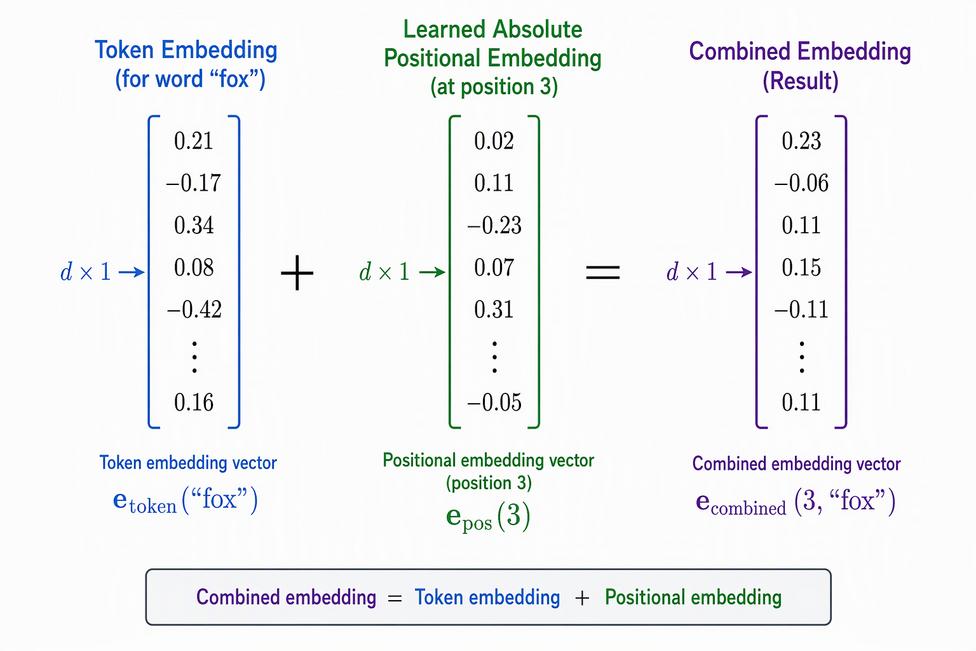
This method treats position as an absolute index learned during training, similar to vocabulary embeddings.
Limitations:
- Fixed maximum sequence length, limiting the model's ability to handle longer sequences than it was trained on.
- Increasing maximum sequence length significantly increases model parameters and memory usage.
GPT-2 uses this method for up to 1,024 tokens but cannot naturally extend beyond that without retraining the position vectors.
2. Sinusoidal Positional Encoding
Introduced in the original Transformer paper, this technique generates position vectors dynamically using sine and cosine functions at varying frequencies.
- Each dimension of the positional vector corresponds to a sinusoidal function oscillating at a different rate.
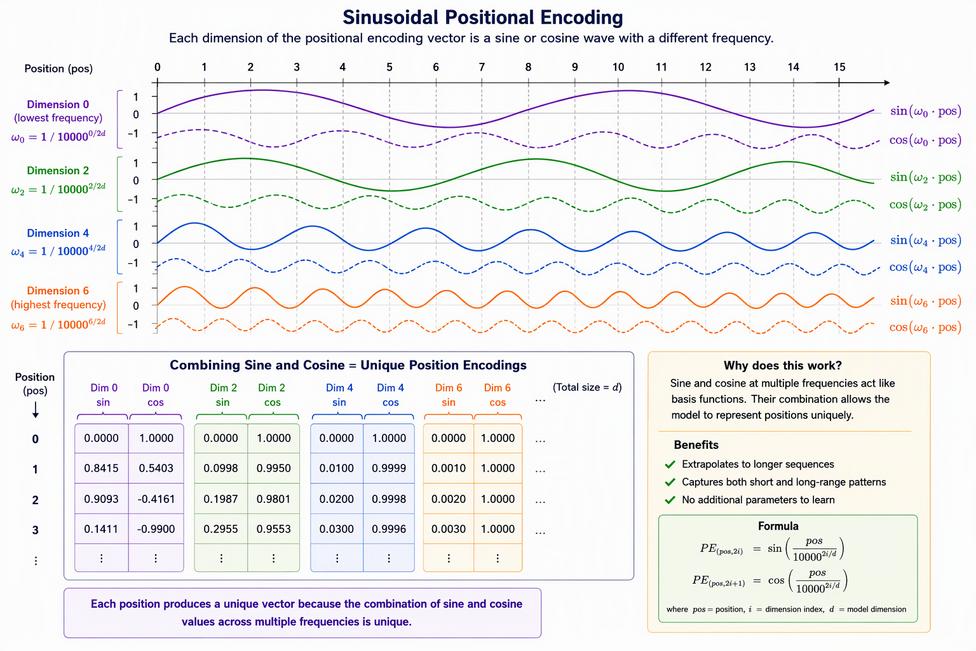
- This creates a unique, continuous positional signature for each position.
Advantages:
- No learned parameters, thus flexible for sequences longer than training length.
- Encodes relative position information effectively.
Mechanism analogy: Like clock hands moving at different speeds, combining multiple waves uniquely specifies each token position.
However, quality for positions far beyond training can degrade.
3. Rotary Positional Embeddings (RoPE)
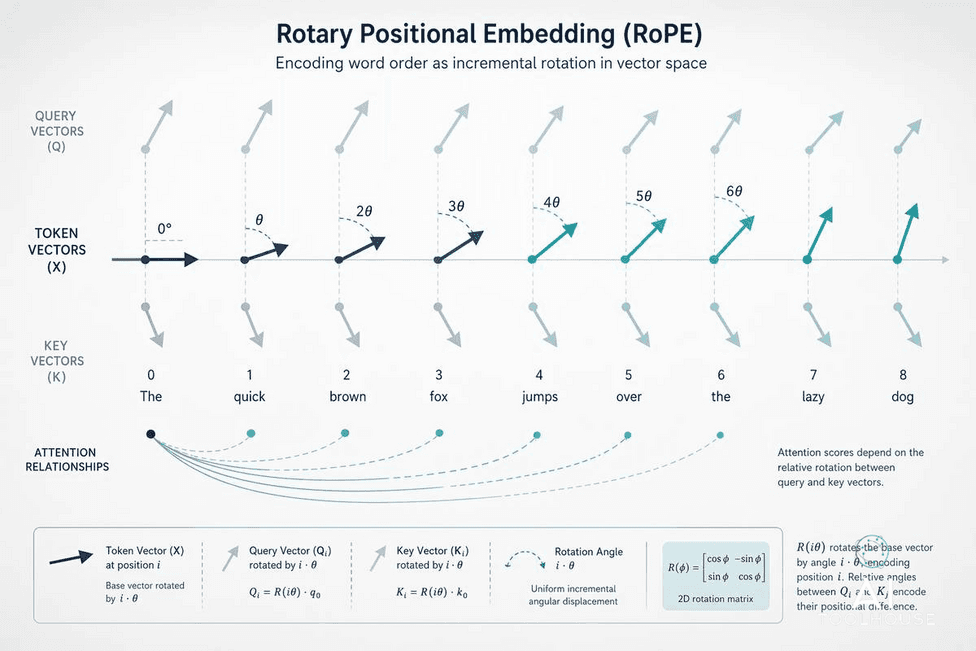
Emerging in 2021, RoPE revolutionized positional encoding by integrating position directly into the attention mechanism without altering token embeddings permanently.
How RoPE works:
- Instead of adding position vectors once, RoPE rotates pairs of dimensions in the query and key vectors by angles proportional to their token positions.
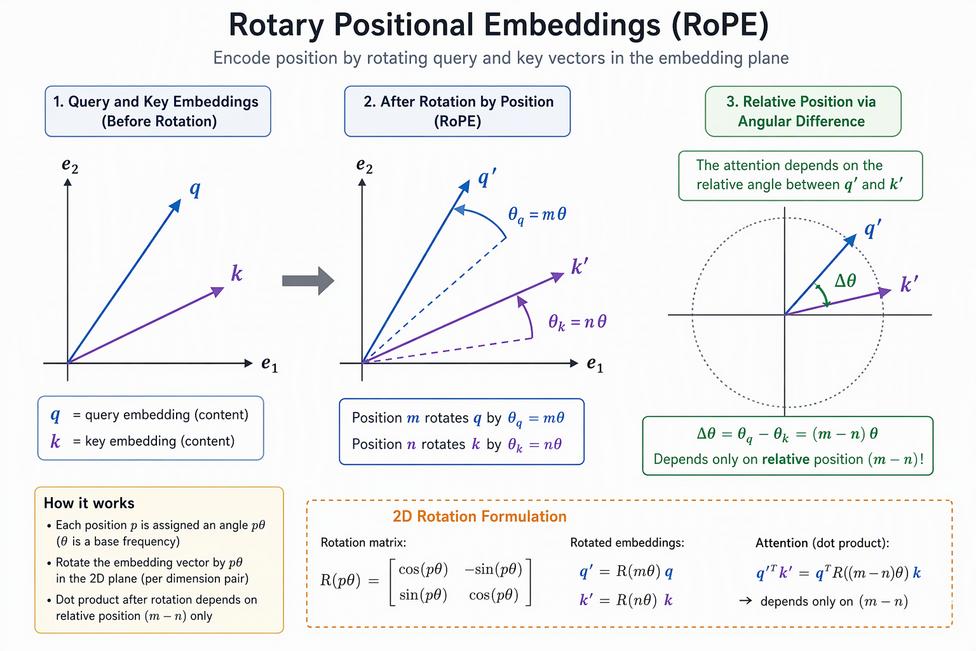
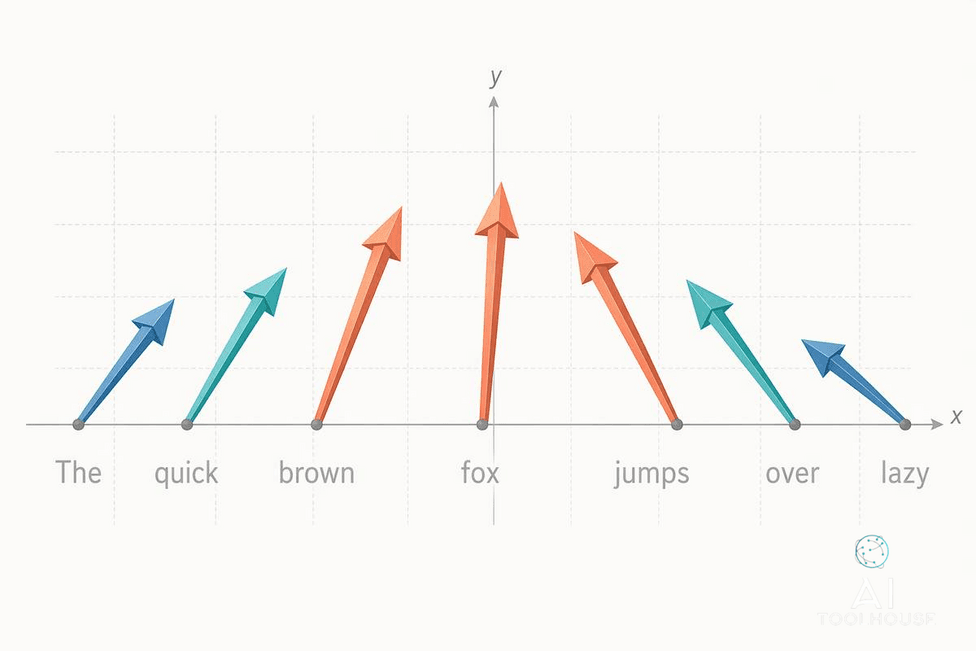
- This rotation changes the direction of vector "arrows," encoding relative positional distances dynamically at every attention layer.
Benefits:
- Captures relative distances between tokens, not just absolute positions.
- Supports long sequences gracefully, maintaining awareness after shifting token windows (e.g., in prefixes).
Illustration: Tokens at positions 5 and 2 generate vectors rotated such that their relative angle corresponds to their distance apart, the same as tokens at positions 105 and 102 with identical relative distance.
This approach ensures that attention scores reflect token proximity naturally, enabling better understanding of token order and context.
Modern Trends in Positional Embeddings
RoPE has become a mainstay in state-of-the-art LLMs like LLaMA, popular for its efficiency and accuracy in encoding position.
Yet research continues exploring variants and hybrids:
- Partial RoPE applies rotation selectively on vector features.
- Learned relative biases adapt distances dynamically.
- Some layers may skip position encoding relying on causal masks and prior layer signals.
Nonetheless, RoPE’s core idea of relative positional encoding dominates modern architectures due to its simplicity and performance.
Summary Comparison of Positional Embedding Methods
| Method | Position Injection | Learned Parameters | Position Representation | Handling Length Beyond Training | Example Usage |
|---|---|---|---|---|---|
| Learned Absolute | Added once to token vectors | Yes | Absolute position | No (fixed max length) | GPT-2 |
| Sinusoidal Encoding | Added once to token vectors | No | Absolute position (via sin/cos) | Yes (but quality varies) | Original Transformer |
| Rotary Positional Embedding (RoPE) | Applied each attention layer via rotation | No | Relative position via vector rotation | Yes, robust | LLaMA, modern LLMs |
Frequently Asked Questions
Q1: Why can’t transformers understand word order naturally? Transformers operate using attention based on dot products, which inherently treat inputs as sets rather than sequences, losing order information without additional encoding.
Q2: What are the main drawbacks of learned absolute positional embeddings? They require a fixed maximum sequence length determined before training and add substantial parameter overhead, limiting scalability.
Q3: How does RoPE differ fundamentally from earlier methods? RoPE applies position information dynamically by rotating query and key vectors in attention layers instead of adding static positional vectors once to the embeddings.
Conclusion
Positional embeddings are critical for LLMs to understand the sequential nature of language and disambiguate meaning conveyed through word order. From early learned absolute embeddings to sinusoidal encodings and the modern rotary method, these techniques enrich token representations with positional context. RoPE’s elegant approach of encoding relative positions through vector rotation has become the leading solution for scalable, accurate comprehension of word order in large-scale language models.
By enabling transformers to capture the nuances of token position, positional embeddings unlock powerful natural language understanding capabilities essential for a wide array of AI applications today and beyond.