

How Positional Embeddings Empower Large Language Models to Grasp Word Order
Explore how Large Language Models (LLMs) use positional embeddings — including learned, sinusoidal, and rotary methods — to understand word order and enhance language comprehension.
On this page
Introduction to Positional Embeddings in LLMs
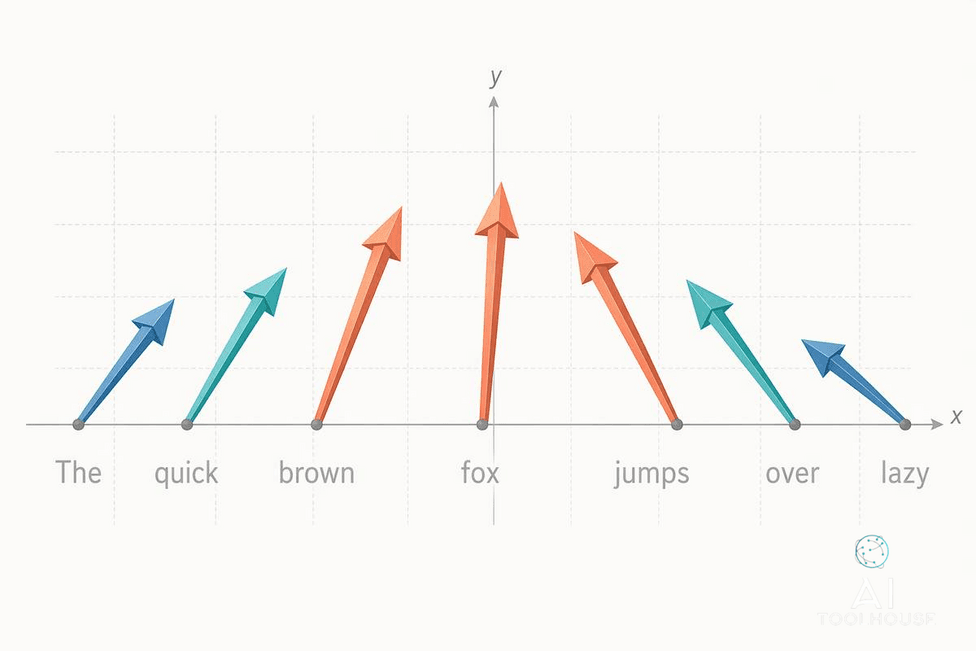
Understanding word order is fundamental to natural language comprehension. While humans instantly grasp the significance of sequence in sentences like "The dog chased the fox" versus "The fox chased the dog," large language models (LLMs) face challenges in capturing such order directly. This is where positional embeddings come into play, allowing LLMs to encode the position of each token within input sequences to maintain meaningful context.
Why Transformers Struggle With Word Order
Transformers, the architectural backbone of modern LLMs, primarily rely on the attention mechanism—a process that computes relationships between tokens via dot product operations on their vector embeddings.
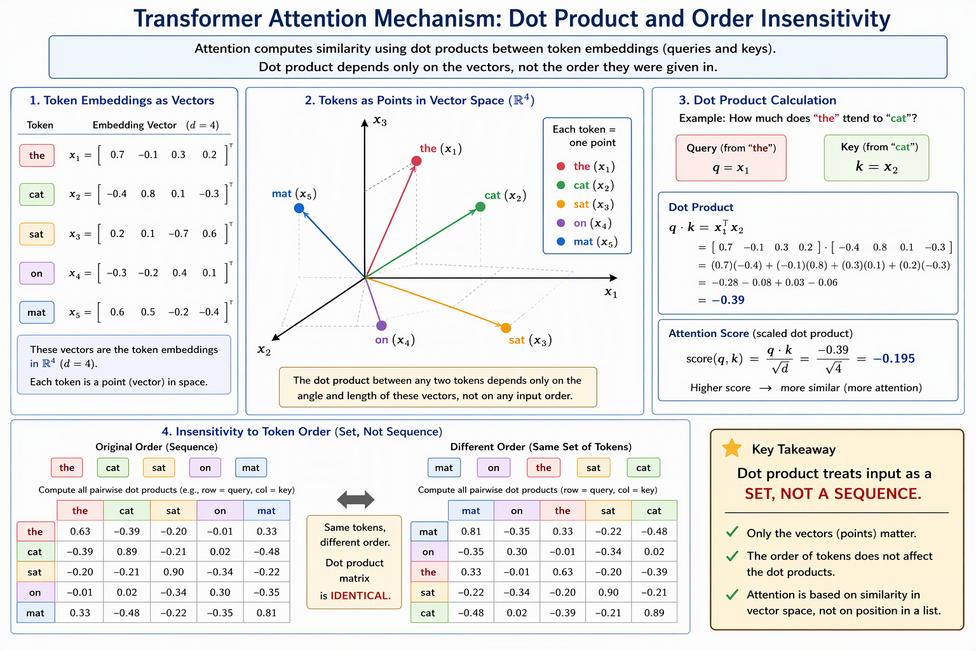
However, dot products are inherently insensitive to the order of vectors, treating the input as a set rather than a sequence.
Think of reading a chat log with all messages but no timestamps; you see the content but not the order. Similarly, without positional information, attention layers cannot distinguish between "fox chased dog" and "dog chased fox," producing identical representations. Although GPT-style causal masking introduces partial ordering by limiting token visibility to preceding tokens, this method alone cannot reliably capture exact token distances or relative word order across longer contexts.
Approaches to Positional Embeddings
To address this limitation, researchers have developed various positional embedding techniques that inject position awareness into token representations.
1. Learned Absolute Positional Embeddings
The simplest approach assigns each position in the input sequence a unique vector, learned during training alongside token embeddings.
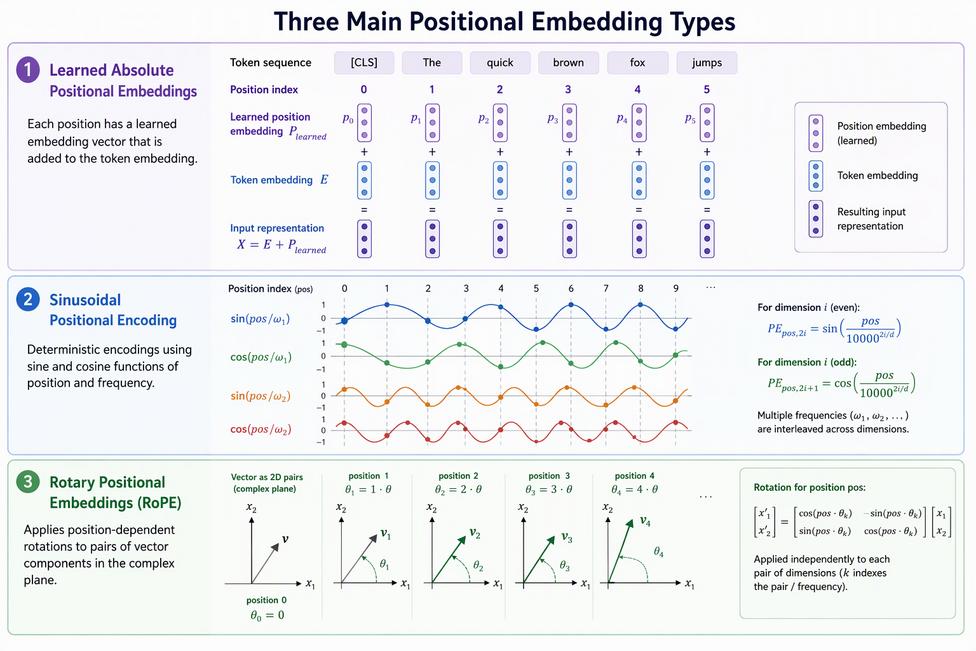
These vectors are added to token embeddings, effectively differentiating the same word appearing at different positions.
Pros:
- Simple conceptual model analogous to numbered theater seats.
- Fully trainable and can adapt position vectors for optimal performance.
Cons:
- Fixed maximum sequence length determined at training time (e.g., GPT-2 uses 1024).
- Large memory overhead if context length increases, making it less scalable.
2. Sinusoidal Positional Encoding
Introduced in the original Transformer paper, this approach generates position vectors using sine and cosine functions of varying frequencies without any learned parameters.
By encoding position as oscillating signals at multiple frequencies—akin to different clock hands moving at distinct speeds—each position yields a unique encoding that models can compute at arbitrary sequence lengths.
Pros:
- No training parameters required.
- Enables model extrapolation to longer sequences than those seen during training.
- Encodes relative distance in a way conducive to attention mechanisms.
Cons:
- Positions beyond the training length are computable but may not maintain perfect quality.
3. Rotary Positional Embeddings (RoPE)
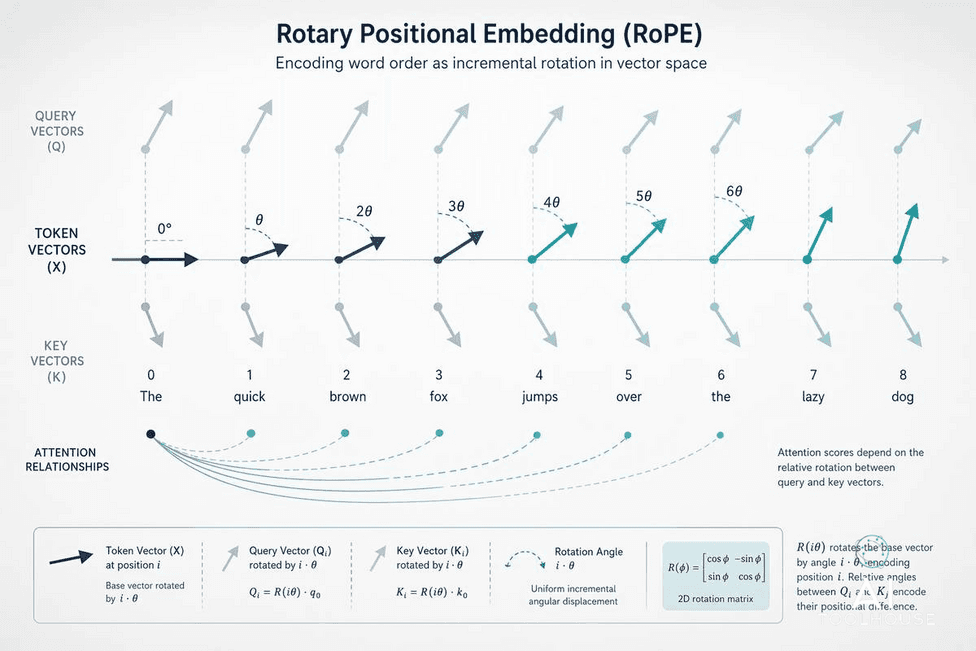
Emerging as a leading modern technique, RoPE introduces positional information by rotating pairs of dimensions in the query and key vectors during attention computation.
Instead of adding static vectors to token embeddings, RoPE applies a rotation transformation per token position on these vectors, preserving the vector magnitude while altering their orientation. This means attention scores derived from dot products inherently reflect relative token distances.
Pros:
- Encodes relative positions naturally, supporting better generalization to long sequences.
- Position is integrated in every attention layer, reinforcing positional awareness.
- Computationally efficient without increasing model parameters.
Cons:
- More complex to implement.
- Slightly different pairing conventions exist among models, requiring careful handling.
How RoPE Encodes Relative Position
Imagine each dimension pair as an arrow in 2D space.
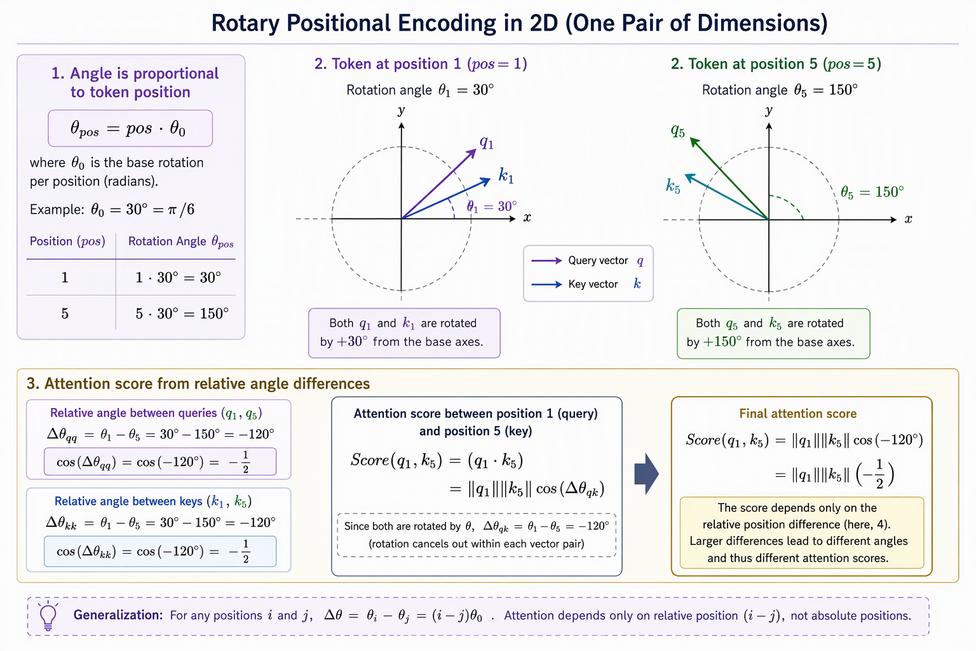
For a token at position 1, the arrow rotates a small angle; for position 5, the rotation is five times larger. Attention compares the angle between these rotated vectors, producing the same attention score for the same relative distances regardless of absolute position. This imparts shift invariance—attention scores depend on relative, not absolute, distances—enhancing the model’s ability to understand context over long ranges.
Comparison of Positional Embeddings
| Feature | Learned Absolute | Sinusoidal | Rotary Positional Embeddings (RoPE) |
|---|---|---|---|
| How position enters | Added once to input | Added once to input | Rotates queries & keys each layer |
| Learned parameters | Yes | No | No |
| Attention sees | Absolute position | Absolute position | Relative position |
| Handles sequences longer than training | No | Partially | Yes |
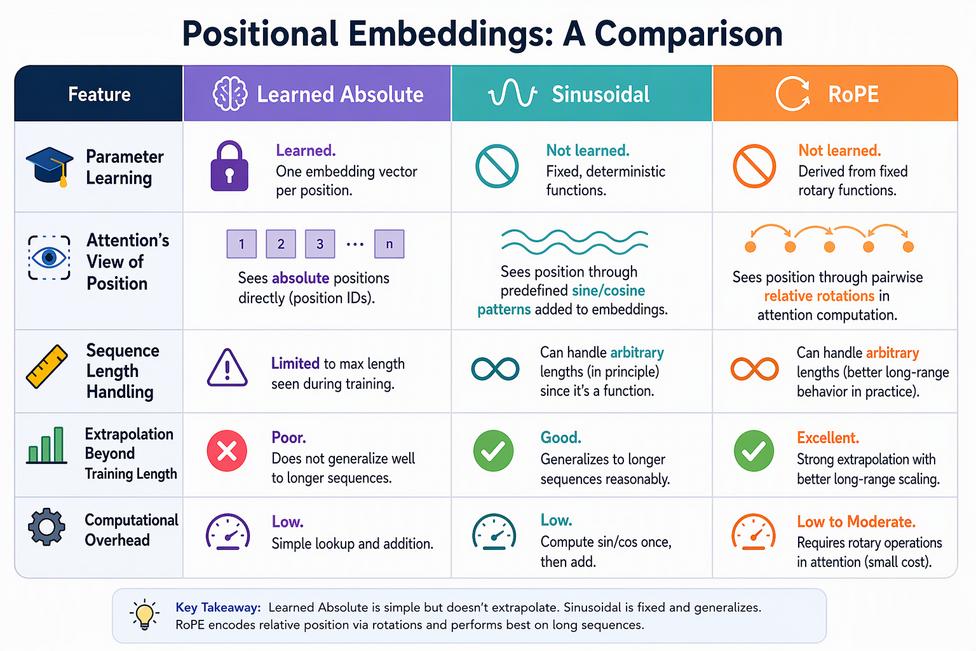
| Model examples | GPT-2, BERT | Original Transformer | LLaMA, Qwen, many modern LLMs |
Modern Developments and Variants
While RoPE remains the dominant method for state-of-the-art LLMs, researchers have introduced innovations:
- Partial RoPE: Rotating only a subset of features to balance complexity and performance.
- Learned Relative Biases: Smaller learned adjustments to attention scores based on token distance for better long-context handling.
- NoPE Layers: Layers skipping positional encoding entirely but relying on causal masks and signals from surrounding layers.
These variants aim to refine positional awareness, especially in ultra-long context scenarios where traditional methods show limitations.
Practical Implications for Language Understanding
Positional embeddings are crucial for LLMs to distinguish meanings dictated by word order, handle sentence structure, and maintain coherence over extended passages. Their effective implementation enables models to perform better on tasks like machine translation, text summarization, question answering, and more.
Without positional embeddings, LLMs would treat input tokens as unordered collections, losing key syntactic and semantic relationships.
Frequently Asked Questions
Q1: Why can’t transformers understand word order naturally? A1: Because attention computes dot products that ignore sequential order, transformers need positional embeddings to encode token positions.
Q2: What limitations do learned absolute embeddings have? A2: They require a fixed maximum sequence length fixed at training time and are not scalable to longer contexts.
Q3: How does RoPE differ fundamentally from earlier methods? A3: Unlike previous approaches, RoPE encodes position by rotating vectors within attention layers, enabling relative positional awareness dynamically.
Conclusion
Positional embeddings are essential mechanisms by which large language models gain awareness of word order—a cornerstone of language understanding. From learned positional vectors to sinusoidal encodings and the more recent Rotary Positional Embeddings, these techniques reflect evolving strategies to embed positions within the transformer architecture.
RoPE, in particular, offers a sophisticated and scalable approach by encoding relative distances directly in the attention process. This enables modern LLMs to handle longer contexts more effectively and maintain the nuanced relationships between tokens critical for nuanced language comprehension.
As LLMs continue to develop, positional embedding strategies will remain a vital area of research ensuring these models comprehend not just the words themselves, but the intricate order that shapes meaning.