

Soup: Streamlining Small LLM Fine-Tuning with a Single YAML Configuration
Explore how Soup simplifies fine-tuning small language models locally using just one YAML file. Understand its process, advantages, comparisons, and practical implementation on modest hardware.
On this page
Introduction to Fine-Tuning Small Language Models
Fine-tuning language models (LLMs) traditionally requires significant technical expertise, access to substantial computational resources, and intricate configurations. However, recent tools like Soup aim to democratize this process by enabling streamlined fine-tuning workflows designed specifically for small LLMs. This article explores the capabilities and inner workings of Soup, focusing on how it leverages a single YAML file to configure efficient local fine-tuning on personal machines, such as Apple Silicon Macs or NVIDIA GPUs.
Understanding Soup: Simplifying LLM Fine-Tuning
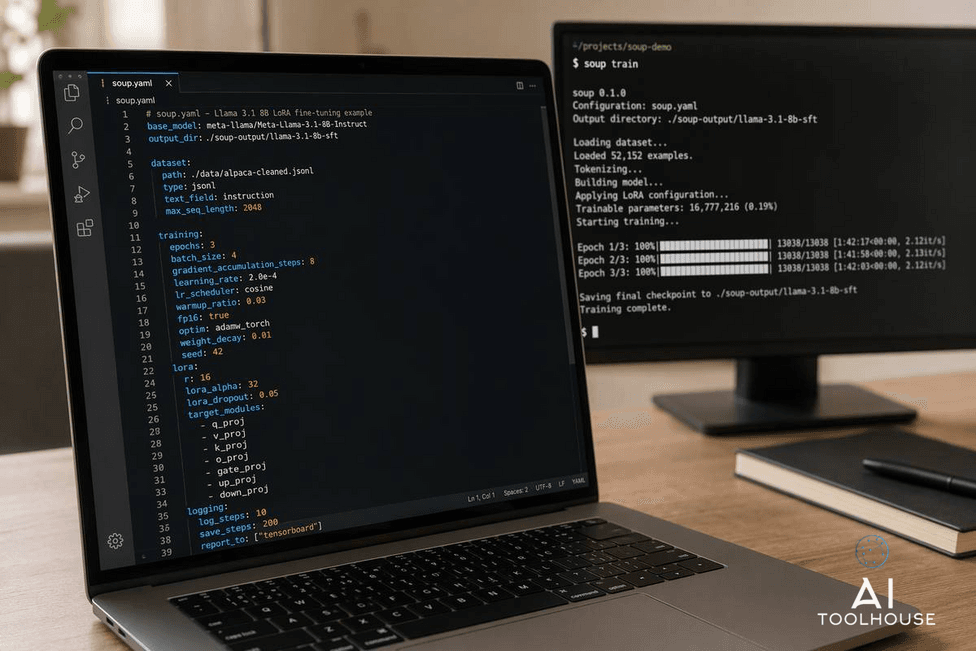
Soup is an open-source command-line interface (CLI) tool developed to fine-tune small language models using supervised learning with minimal setup. The key innovation is its declarative YAML recipe system that consolidates the entire fine-tuning pipeline — from specifying data to training parameters — into one concise configuration file.
Core Components and Workflow
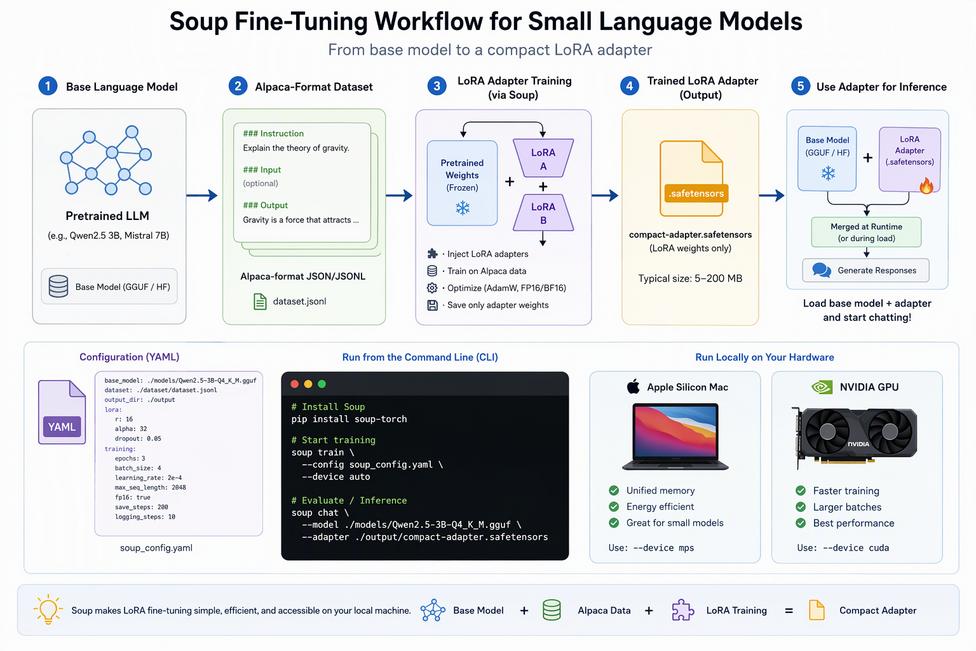
- Base Model: Soup starts with a publicly available foundational model (e.g., Qwen2.5-0.5B-Instruct), which is automatically downloaded if not present locally.
- Training Data: The tool accepts an Alpaca-format JSONL dataset where each example pairs an instruction and input with a desired output for supervised fine-tuning.
- LoRA Adapter Training: Instead of modifying the full model weights, Soup uses Low-Rank Adaptation (LoRA) to train small adapter modules. This approach keeps the base model static and only learns a lightweight adapter, greatly reducing resource requirements.
- Single YAML Configuration: Users define the entire training setup in a
soup.yamlfile, specifying model details, dataset paths, training hyperparameters, and hardware backend (e.g., Apple Silicon MLX or CUDA for NVIDIA GPUs). - Command Execution: Running a single CLI command processes the YAML, launches training, and produces a compact adapter file representing the fine-tuned model.
Advantages of Using Soup
- Minimal Setup: No manual downloads of base models or explicit environment juggling — the tool manages these automatically.
- Local Training: Fine-tuning is done entirely on local hardware with modest requirements, avoiding cloud dependency or API keys.
- Compact Outputs: The resulting adapter file is small (a few megabytes), facilitating easy distribution and deployment.
- Flexible Hardware Support: While optimized for NVIDIA GPUs, Soup also supports Apple Silicon Macs with dedicated backend settings.
- Simple Experimentation: Users can test fine-tuned models immediately, allowing quick iteration and format/style learning from minimal examples.
Practical Example: Training an Incident Update Writer
To illustrate Soup’s usability, consider training a model to transform raw incident notes into succinct, structured updates containing three lines: STATUS, IMPACT, and NEXT steps.
- Create Training Data: Write a small dataset of input notes paired with the exact desired formatted output in JSONL. This dataset includes examples with consistent instructions to standardize the output.
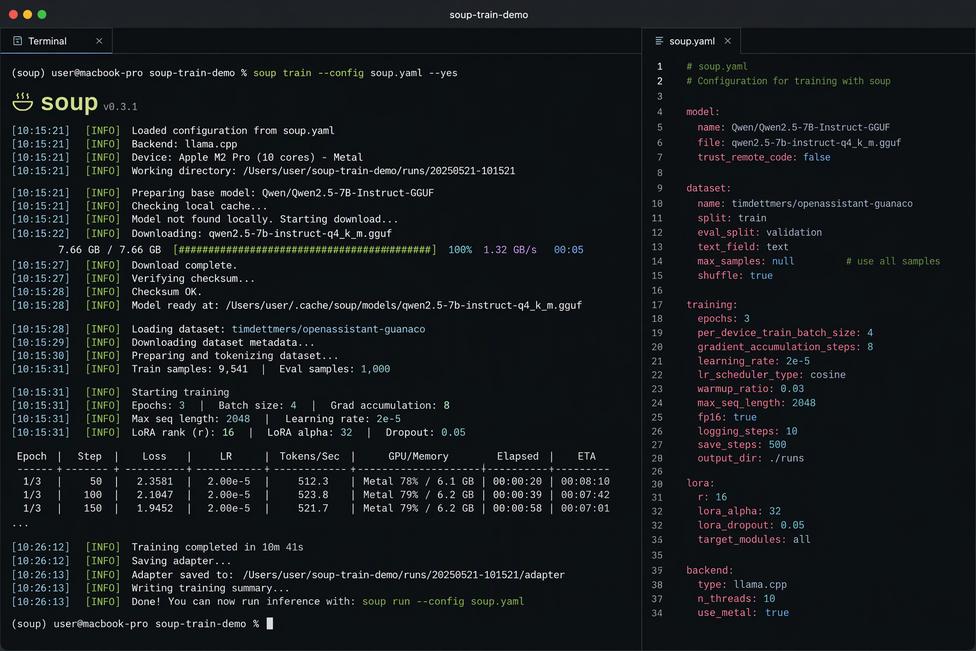
- Write YAML File: Define the
soup.yamlwith the base model, dataset location, validation split, training epochs, learning rate, batch size, and backend. - Run Training: Execute
soup train --config soup.yaml --yes. The base model auto-downloads, and fine-tuning starts on local hardware.
- Test the Model: Generate prompts using the same instruction and evaluate output quality in comparison to the base model.
This exercise demonstrates how Soup trains a model to adhere to a format, reducing hallucinations and enforcing output uniformity, albeit with room for improvement on label accuracy and consistency.
Comparing Soup to Other Fine-Tuning Tools
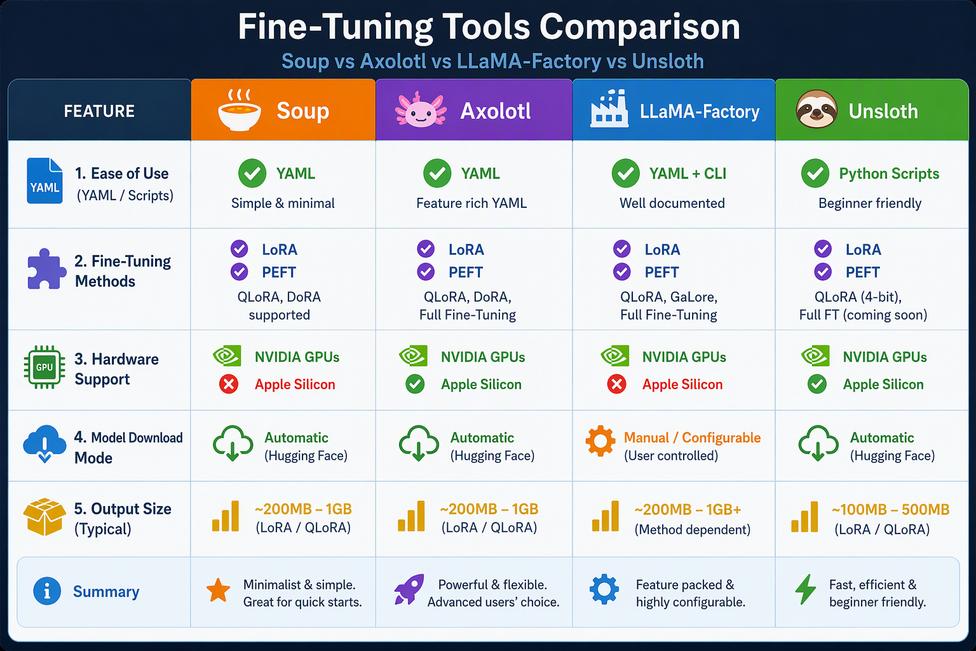
Several frameworks exist for LLM fine-tuning, including Axolotl, LLaMA-Factory, and Unsloth.
| Feature | Soup | Axolotl | LLaMA-Factory | Unsloth |
|---|---|---|---|---|
| Ease of Use | Single YAML config, CLI | Script-based, more manual | Script and config files | Configuration scripts |
| Fine-Tuning Method | LoRA adapters | LoRA and PEFT methods | LoRA | PEFT with QLoRA |
| Hardware Support | NVIDIA GPUs, Apple Silicon | Mainly NVIDIA GPUs | NVIDIA GPUs preferred | NVIDIA GPUs |
| Model Download | Automatic | Manual or scripted | Manual | Manual |
| Output Size | Small adapter file (~2MB) | Small adapters | Small adapters | Small adapters |
Soup’s notable differentiator is the highly simplified YAML-focused workflow that minimizes the technical barrier to starting fine-tuning projects on small LLMs locally.
Best Practices for Effective Fine-Tuning with Soup
- Data Quality and Variety: Fine-tuning on a very small dataset (e.g., a dozen examples) mainly teaches formatting conventions rather than robust understanding. Broader, more varied datasets improve reliability.
- Validation and Testing: Use separate validation splits and independent test prompts to evaluate model improvements realistically.
- Prompt Consistency: Ensure that test prompts include the same instructions as training data to maintain output adherence.
- Training Duration: Longer training epochs may improve format learning but risk overfitting, so monitor validation loss and test results.
- Hardware Selection: Use MLX backend on Apple Silicon Macs or CUDA backend on NVIDIA GPUs to optimize performance.
Practical Implications and Use Cases
Soup empowers individual developers, researchers, and small teams to customize LLM behavior locally without relying on expensive cloud infrastructure or extensive programming. Potential applications include:
- Automating incident status report formatting.
- Customizing chatbots with industry-specific language.
- Developing lightweight domain adaptation for niche tasks.
- Experimenting with style and tone adjustments in generated text.
By making fine-tuning approachable, Soup helps bridge the gap between out-of-the-box general models and tailored deployments.
Conclusion
Soup represents a streamlined, practical approach to fine-tuning small language models locally through a simple YAML configuration and a unified CLI workflow. Its use of LoRA adapters conserves resources while effectively teaching style and format from limited examples on modest hardware, including Apple Silicon Macs and NVIDIA GPUs.
While initial experiments showcase its potential to improve output formatting and reduce hallucinated content, reliability and detailed accuracy still depend on dataset quality and training extent. Soup is not an all-encompassing solution but a valuable enabler for accessible LLM customization.
This tool exemplifies a significant step toward democratizing fine-tuning, allowing users to move swiftly from example data to functional, tested adapters with minimal friction. For practitioners seeking a no-frills, locally executed fine-tuning experience, Soup is an efficient and promising choice.