

Mastering Agentic Evaluations: Building and Maintaining Advanced AI Assessment Systems
Explore the evolving methodology of agentic evaluations in AI, their construction, maintenance, and significance for deploying autonomous agents reliably in real-world domains.

On this page
Understanding Agentic Evaluations in AI
As AI systems advance, traditional evaluation methods centered on question-answer formats no longer suffice. Agentic evaluations have emerged as a crucial next step, assessing not just responses but the agent's actions within an environment. These evaluations measure an AI system's ability to perform tasks autonomously, manipulate tools, and interact dynamically, offering deeper insights into operational capabilities.
The Evolution of AI Evaluation
AI evaluation has progressed through three key eras:
- Question-Answer Benchmarks: Focused on verifying the correctness of outputs, such as knowledge tests.
- Agentic Benchmarks: Expanded scope to evaluating the agent’s behavior and interventions within task environments.
- Multi-Agent and Swarm Evaluations: Assessing team coordination and collective outputs among multiple interacting AI agents.
This article focuses on the second era — agentic evaluations — due to their increasing prominence in practical deployments and their role as a foundation for understanding complex AI interactions.
Core Components of Agentic Evaluations
Agentic evaluations are multifaceted systems that integrate several elements working in concert:
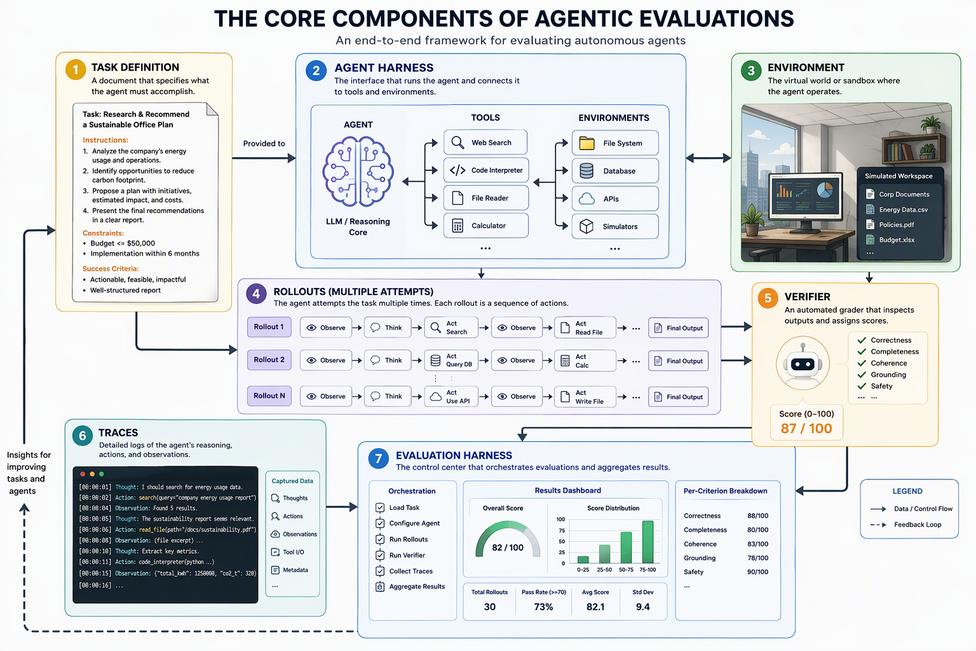
- Task Definition: Provides detailed instructions that frame an agent’s objectives.
- Agent Harness: Software interfacing between the AI model and tools or environments, enabling actions like command execution.
- Environment: A controlled setup where the agent operates, complete with necessary resources and simulations.
- Rollouts: Individual attempts by the agent to complete assigned tasks.
- Verifier: Automated grading that inspects the environment's final state or the agent’s output to determine success.
- Traces: Detailed records of the agent’s decisions, commands, and observations throughout a rollout.
- Evaluation Harness: Manages the orchestration of tasks, aggregation of scores, and storage of results.
Each element can be independently inspected and improved to enhance the robustness and transparency of the evaluation.
Building an Agentic Evaluation: A Stepwise Approach
Creating an effective agentic evaluation requires deliberate planning and validation.
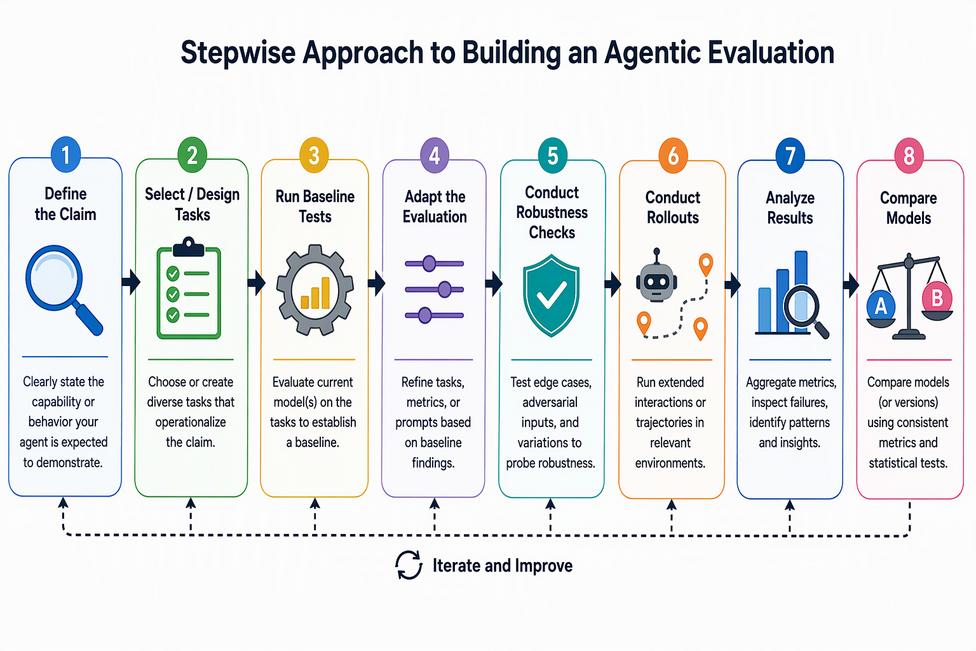
The process typically entails:
Defining the Claim: Articulate a clear, testable statement about what skill or capability the agent is expected to demonstrate.
Selecting or Designing Tasks: Leverage existing open benchmarks when possible to conserve effort, adapting tasks to domain-specific requirements and ensuring relevance.
Running Baseline Tests: Execute known reference solutions to verify that the environment and verifier function correctly.
Adapting the Evaluation: Modify tasks and instructions to reflect real-world complexities, including environment variables and updated success criteria.
Robustness Checks: Introduce no-op agents and shortcuts to validate that the verifier accurately discriminates successful from unsuccessful attempts.
Conducting Agent Rollouts: Run multiple attempts with different models or configurations to gather performance data.
Analyzing Results and Traces: Study rollouts to identify failure modes such as premature task completion or dependency issues.
Comparing Multiple Models: Evaluate various AI agents on the same task set to benchmark relative capabilities.
By iterating through these steps, evaluators can build reliable benchmarks tailored to specific agentic tasks while balancing complexity and interpretability.
Maintaining and Evolving Agentic Evaluations
Benchmark saturation—where tasks no longer meaningfully differentiate between models—is a noted challenge. Maintenance strategies include:
- Ongoing Validation: Involve domain experts to confirm task relevance, refine grading tolerances, and assess construct validity.
- Error Reporting and Correction: Encourage community review and make corrections publicly available to maintain benchmark integrity.
- Strategic Openness: Share code, infrastructure, scoring methods, and non-sensitive data openly to foster reproducibility while protecting sensitive test items to avoid data contamination.
- Task Refreshing: Update or retire tasks to prevent overfitting and saturation, introducing harder challenges to continue differentiating agent capabilities.
Balancing Transparency and Security
The openness of an evaluation system influences both its utility and risk:
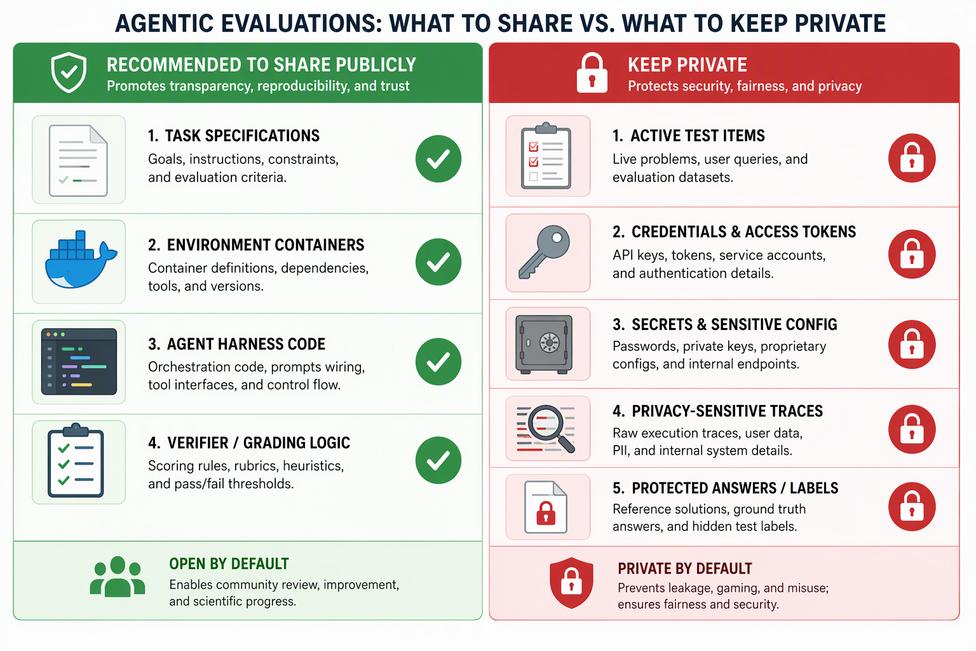
| Component | Recommended Public Sharing | What May Remain Private |
|---|---|---|
| Task Specifications | Instructions, categories, public development datasets | Active test items, answers |
| Environment | Container definitions, synthetic fixtures | Credentials, licensed assets |
| Agent Harness | Code, tool interfaces, pinned versions | Secrets, sensitive implementations |
| Rollouts & Traces | Public traces, analysis code, reviewed excerpts | Privacy-sensitive traces |
| Reference Solutions | Solution methods and example code | Solutions revealing protected task details |
| Evaluation Harness | Orchestration scripts, scoring aggregation | Credentials, restricted configurations |
| Verifier | Grading logic, rubrics, examples | Reference answers that reveal sensitive data |
| Claims & Task Design | Intended use and validation evidence | Sensitive source material |
| Results | Scores, costs, model configurations | Detailed task-revealing data |
This balanced approach allows researchers to audit and build upon benchmarks effectively while mitigating the risks of test contamination or exposure of proprietary information.
Practical Implications and Use Cases
Agentic evaluations are foundational for real-world AI deployments requiring autonomy and tool use. Examples include:
- Scientific Research Automation: Evaluating agents tasked with analyzing experimental data, such as fitting spectral peaks in physics or chemistry labs.
- Software Development: Assessing AI systems that plan, code, and troubleshoot in development environments.
- Enterprise Automation: Measuring AI agents managing workflows with dynamic decision-making capabilities.
These evaluations provide confidence in AI capabilities by reflecting realistic operational contexts more fully than static question-answer benchmarks.
Conclusion
Agentic evaluations represent a crucial advancement in AI assessment, shifting focus from static responses to dynamic, goal-directed behavior within defined environments. Building and maintaining these evaluations demands careful task design, robust grading mechanisms, and ongoing validation to ensure accuracy and relevance.
Strategic open sourcing and community engagement play pivotal roles in refining benchmarks, enabling transparency, and preventing saturation. As AI systems increasingly deploy as autonomous agents, well-constructed agentic evaluations will be indispensable tools for trust, verification, and continuous improvement in AI technologies.