

Harnessing Time-Series Models in the Streamhouse for Real-Time Intelligence and Optimization
Explore how time-series models integrated into the Streamhouse architecture enable real-time forecasting, anomaly detection, and operational optimization across industries, revolutionizing decision-making processes with streaming data.
On this page
Introduction to Time-Series Models in Streaming Environments
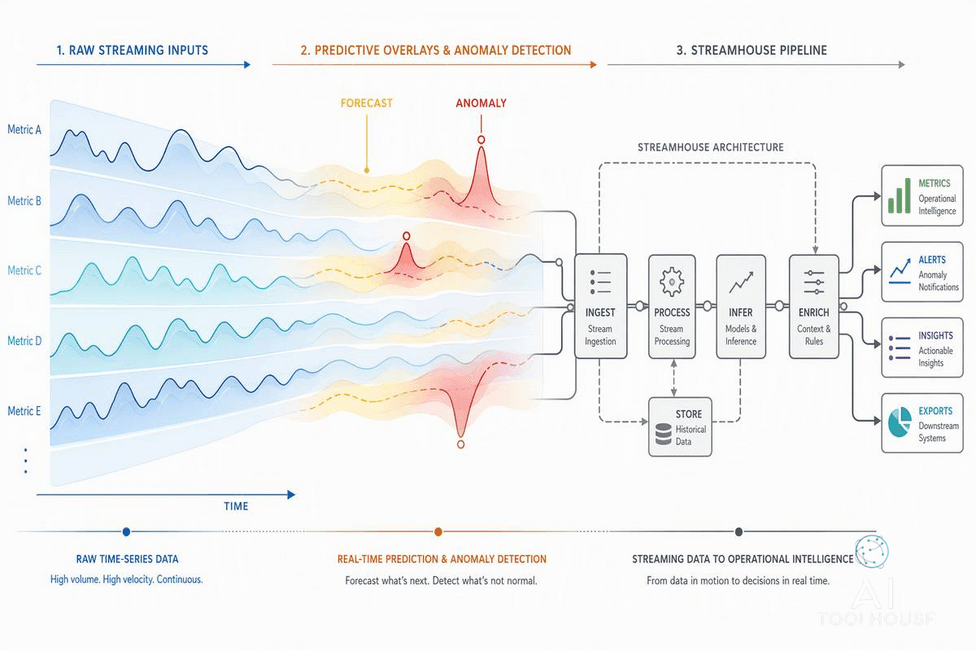
In today's fast-paced business world, the continuous generation of data presents both an opportunity and a challenge. Every transaction, sensor reading, or system event records a dynamic and ever-changing timeline—known as a time series. Capturing and analyzing these signals in real time to make proactive, impactful decisions has been a long-standing goal. Recent advances integrating time-series foundation models directly into streaming platforms, such as the Streamhouse model combined with Confluent and Apache Flink, represent a paradigm shift in how organizations derive actionable intelligence.
What Is the Streamhouse and Why It Matters
The Streamhouse is an architectural concept that converges real-time data ingestion, processing, governance, and querying capabilities into a unified platform. Instead of relying on periodic batch updates, the Streamhouse ensures a continuous, low-latency pipeline capturing current business context. This live data foundation allows applications, AI agents, and analytics tools to operate on up-to-date, synchronized information, avoiding stale insights that can lead to suboptimal decisions.
Within this environment, time-series models act as a predictive and analytical layer, transforming raw sequential data into foresight and anomaly detection.
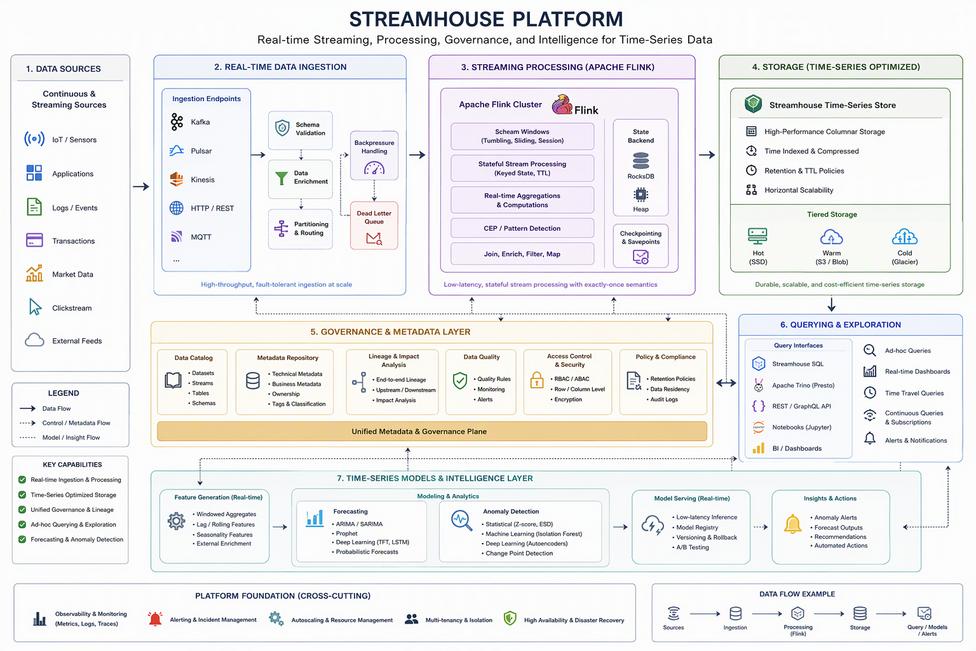
Using Apache Flink, streaming data is enriched and prepared dynamically, allowing models to forecast future values, detect irregularities, and provide semantic interpretations on-the-fly.
Time-Series Foundation Models: A New Frontier in Numerical Data
Time-series foundation models extend the concept of pretrained AI from textual and visual domains into numerical time series data. These models learn generalized patterns from vast and diverse historical datasets and then apply this knowledge to new, unseen series without requiring bespoke training for each new case.
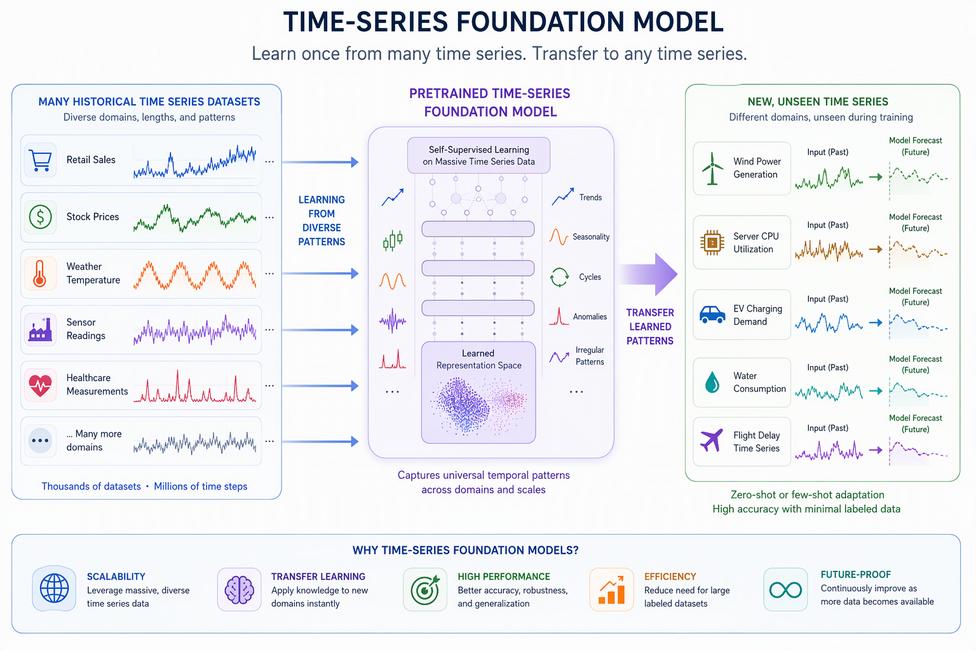
This transferability accelerates deployment and enhances model scalability.
Key benefits include:
- Scalability: A single pretrained model can serve numerous time series, reducing development complexity.
- Continuous Updating: Models can refresh forecasts as new data streams in, maintaining relevancy.
- Operational Integration: Outputs are delivered into streaming applications for immediate action.
- CPU Efficiency: Models are optimized to run on standard CPUs alongside streaming pipelines, bypassing the need for costly GPU infrastructure.
Practical Applications and Use Cases
1. Production Optimization in Manufacturing
Quality control in manufacturing often suffers delays between data collection and actionable insight. Through continuous telemetry monitoring and real-time forecasting of critical metrics (like overrun in ice cream production), operators can anticipate quality deviations hours ahead. With an integrated optimization layer, suggested adjustments to machinery settings can be evaluated proactively, reducing waste, energy consumption, and rework.
2. Anomaly Detection in Retail Operations
Detecting unusual sales patterns or inventory discrepancies can be challenging amid normal seasonal fluctuations. AI-powered anomaly detection models dynamically establish expected ranges for each product and store, flagging deviations without the need for manual threshold settings. Linking these alerts with inventory and contextual data guides operational teams to precise corrective responses, such as replenishing stock or investigating shelf issues.
3. Supply Chain and Inventory Forecasting
Maintaining optimal stock levels across diverse products and locations is a classic supply chain challenge. Time-series forecasting models provide probabilistic demand predictions at granular levels, refreshed as new sales data arrives. Coupling these forecasts with inventory status and lead time enables the generation of reorder points and purchase orders, supporting just-in-time inventory strategies.
4. Fraud Detection in Banking
Individualized time-series models of cardholder behavior offer a nuanced view beyond generic fraud thresholds.
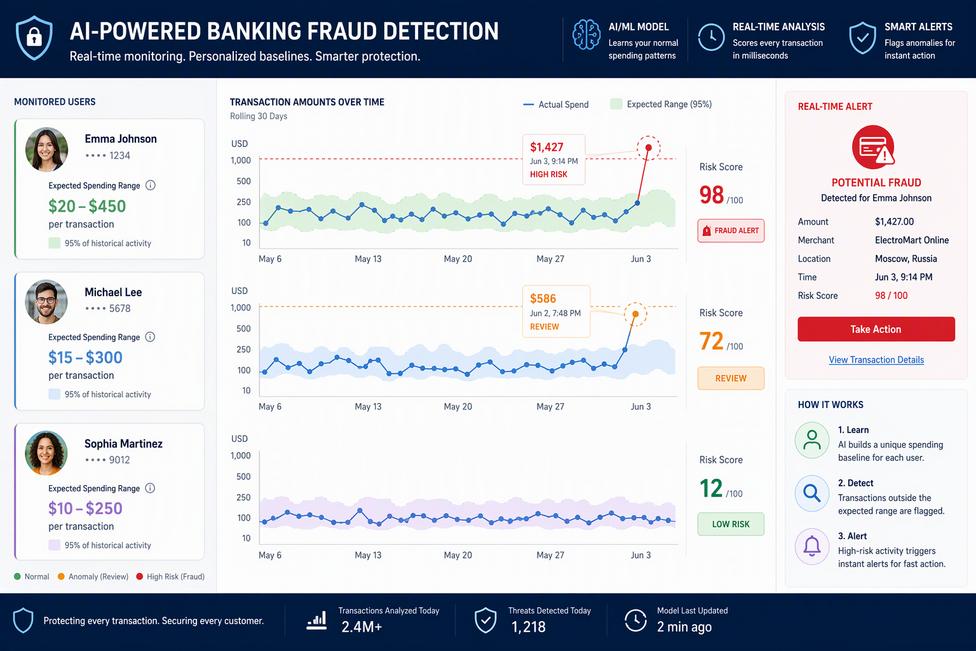
By evaluating each transaction against a personalized expected spending range, suspicious activities can be identified more accurately. This signal acts in concert with existing rules and models to prompt appropriate actions such as stepped-up authentication or blocking.
5. Algorithmic Trading Optimization
Trading large orders requires balancing market impact with completion speed. Real-time volume forecasting with time-series models informs the pacing of order slices, adapting to changing market conditions intra-day. This dynamic scheduling helps traders manage execution risk and optimize outcomes.
6. Semantic Search for Pattern Similarity
Beyond prediction, time-series embeddings enable semantic similarity searches across sensor data. Reliability engineers can query for past occurrences of complex patterns to support root cause hypotheses, improving maintenance and troubleshooting workflows.
Industry-Specific Impacts
- Industrial AI: Real-time quality control, anomaly alerts, and setpoint optimization converge to create digital twins operating within operational cycles.
- Retail: Integrated forecasting and anomaly detection streamline inventory management and sales promotions.
- Banking: Enhanced fraud detection and trading algorithms leverage granular, event-level insights.
- Airlines: Forecasting disruptions and optimizing gate and crew scheduling improve operational resilience.
Differentiators and Technical Advantages
| Feature | Traditional Batch Analytics | Streamhouse Time-Series Models |
|---|---|---|
| Data Freshness | Batch intervals | Continuous streaming, low-latency updates |
| Model Scalability | Individual model per series | Pretrained foundation model serving multiple series |
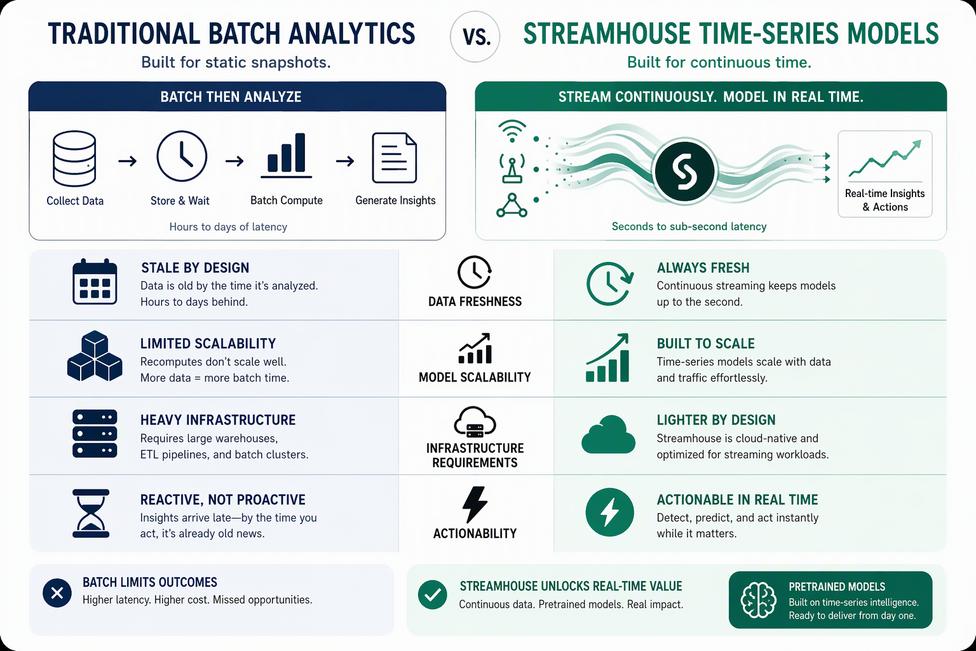
| Deployment Infrastructure | Often GPU required | Efficient CPU execution integrated in streaming pipeline | | Actionability | Post-hoc insights | Real-time forecasts and anomaly detection feeding operational apps |
Challenges and Considerations
While the integration of time-series models into streaming environments brings transformative potential, organizations should consider:
- Data Quality and Governance: Streaming data must be well-governed to avoid propagating errors.
- Model Selection and Configuration: Proper tuning and fine-tuning may be required for domain specificity.
- Operational Integration: Aligning model outputs with reliable automated or human-in-the-loop decision workflows.
Conclusion
The convergence of time-series foundation models with streaming platforms such as the Streamhouse architecture heralds a new era of real-time intelligence. Organizations can now anticipate operational variations, detect anomalies promptly, and optimize processes dynamically—all within their existing data ecosystems. This transformative capability spans industries from manufacturing to retail, banking, and beyond, offering competitive advantages through timely, data-driven actions. As models continue to evolve and integration deepens, time-series intelligence embedded in streaming workflows will become an indispensable asset for businesses seeking agility and precision in decision-making.