

Advancing Real-World Robotics: The Breakthrough of RoboTrack Point Tracking
Explore how RoboTrack revolutionizes real-world robotic manipulation with advanced point tracking, offering improved accuracy and adaptability in cluttered, dynamic environments through novel simulation data and benchmarking.
On this page
Introduction to Point Tracking in Robotic Manipulation
Robotic manipulation in real-world environments demands precise and continuous perception of object positions and movements. The ability of a robot to track specific points on an object or its gripper throughout a task is pivotal for tasks ranging from assembly to laboratory automation. This challenge is intensified by cluttered scenes, occlusions, and varying camera angles.
Point tracking technology addresses this need by following designated points frame-by-frame in video sequences, predicting their visibility even when obscured. These point trajectories enable robots to learn from demonstrations, improve motion planning, and better model object dynamics.
The RoboTrack Innovation: Benchmark and Training Suite
Released by the Allen Institute for Artificial Intelligence (AI2), RoboTrack provides a comprehensive benchmark and synthetic training dataset tailored specifically for point tracking in robotic manipulation.
RoboTrack-Bench: A Real-World Focused Benchmark
RoboTrack-Bench consists of 307 meticulously human-annotated videos extracted from diverse datasets including DROID, Ego-Exo4D, MolmoAct 2, and EgoVerse.
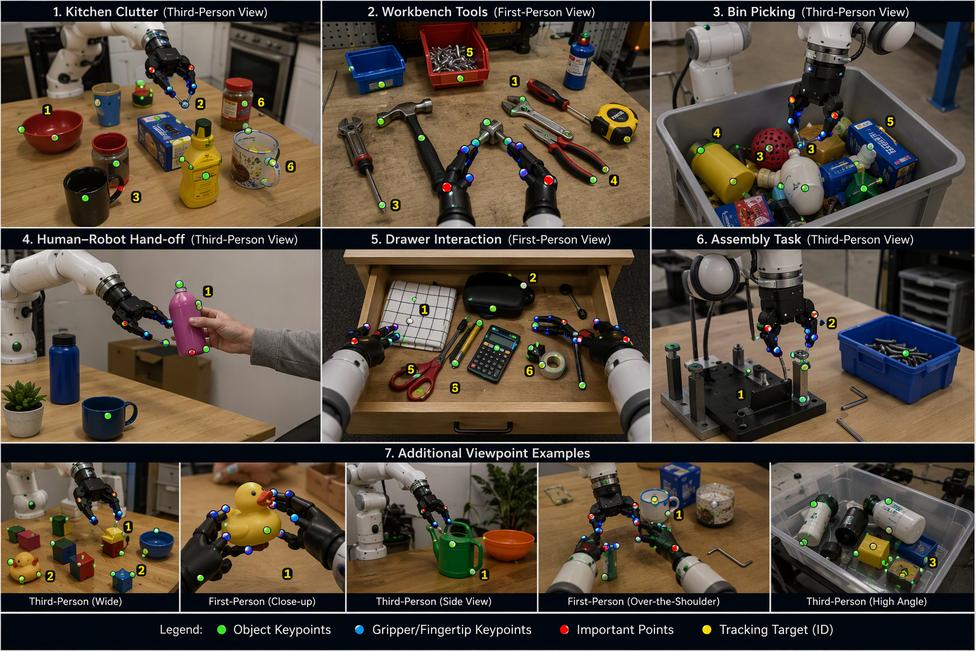
It presents a variety of robotic and human hand interactions with objects under challenging conditions:
- Cluttered environments
- Occlusions by grippers
- First-person and third-person viewpoints
Across these videos, annotators track 2,522 points, prioritizing those that move or become occluded over static points, ensuring robust evaluation of tracking algorithms under realistic complexities.
RoboTrack-15M: Synthetic Training Data from Simulation
Beyond benchmarking, RoboTrack introduces RoboTrack-15M, comprising 15 million dense point tracks derived from 3,000 simulated robot manipulation videos generated with Ai2’s MolmoSpaces environment. Simulations involve robots manipulating everyday objects within realistic indoor scenes captured from two camera perspectives.
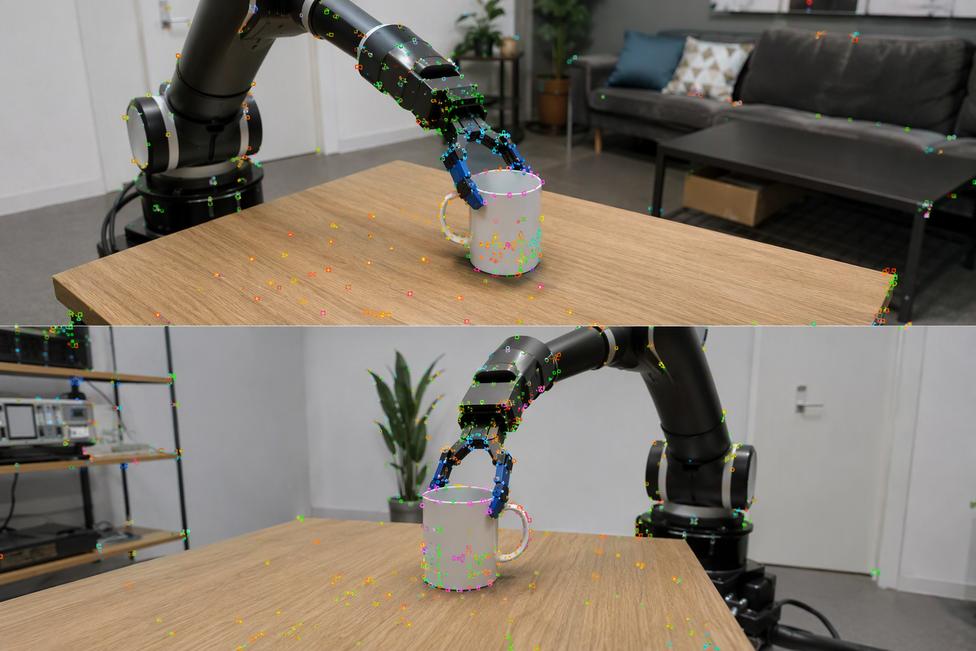
This synthetic dataset fills a critical gap by focusing on robot-object interactions rather than generic object motion, furnishing valuable training examples that enhance a tracker's ability to handle real manipulation scenarios.
Performance Challenges in Real-World Tracking
Evaluations conducted on RoboTrack-Bench reveal that current state-of-the-art trackers such as CoTracker3, BootsTAPNext, AllTracker, and CoWTracker experience significant performance drops compared to older benchmarks. This indicates the difficulty of robust tracking in varied, dynamic manipulation contexts.
Notably, the best off-the-shelf tracker saw a drop of up to 6.6 Average Jaccard (AJ) score points when shifting from established benchmarks to RoboTrack-Bench, highlighting overlooked weaknesses in real-world conditions.
A comparative analysis showed that training solely on synthetic or simpler datasets doesn’t fully prepare models for the complexities of actual robot tasks. Models fine-tuned with RoboTrack-15M consistently improved tracking accuracy across multiple benchmarks.
RoboTracker and RoboTracker-Warp: Enhanced Tracking Models
AI2 released two new point tracking models fine-tuned on RoboTrack-15M:
- RoboTracker: A lightweight model based on AllTracker with optimized performance for robotic use cases.
- RoboTracker-Warp: A larger, high-capacity model built upon CoWTracker that achieves state-of-the-art results across most robotic manipulation benchmarks.
Both models show tangible improvements, particularly RoboTracker-Warp, which leads on four out of five evaluated benchmarks, demonstrating the value of task-specific synthetic training data.
Practical Application: Improving Robotic Precision in Wet-Lab Automation
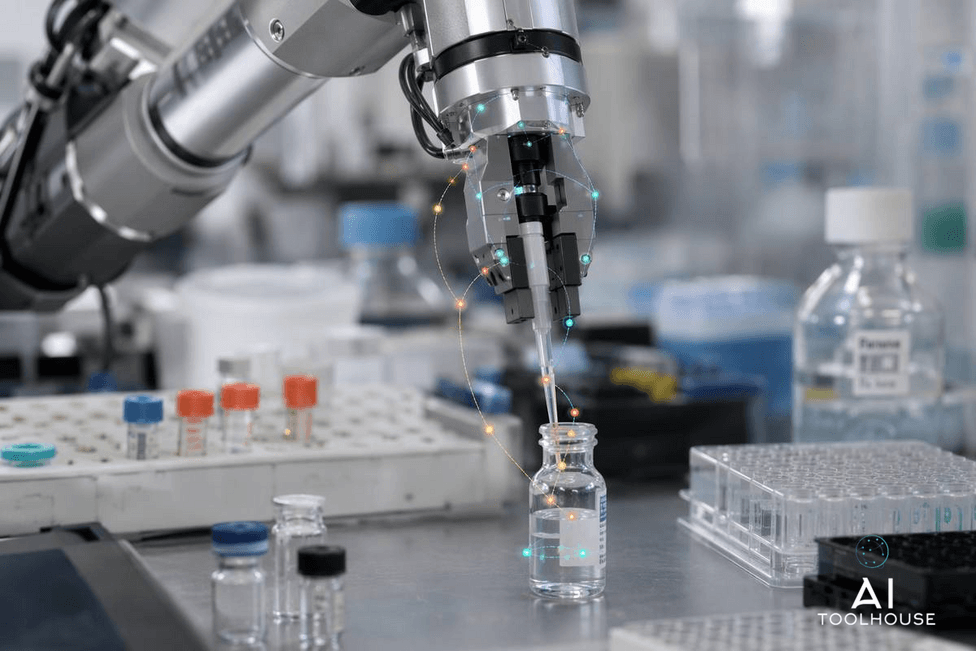
A compelling demonstration of RoboTrack’s practical value is its use in guiding a robot performing pipetting tasks in a wet-lab environment. Precise alignment of the pipette tip with vial openings is critical, with positional accuracy required within millimeters.
Three methods to estimate the vial’s movement during task execution were compared:
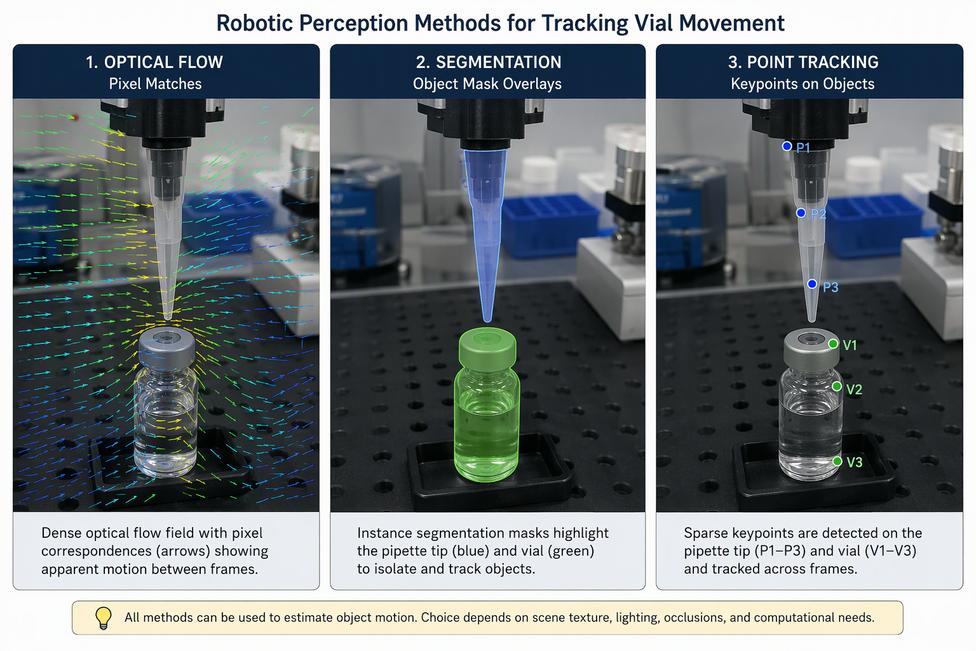
- Optical flow: Matches raw pixels but struggles with large motions and occlusions.
- Object masks: Uses segmentation but fails under occlusion or ambiguous visuals.
- Point tracking with RoboTracker: Maintains continuous tracking despite occlusions and positional changes.
Testing across 20 vial layouts, RoboTracker-based tracking successfully completed 17 full transfers, outperforming object mask (8 successes) and optical flow methods (5 successes). This performance underscores the robustness and precision advantage of point tracking in complex real-world robotic tasks.
Key Differentiators and Technical Insights
Human-Verified, Diverse Real Data: RoboTrack-Bench’s exhaustive human annotation across multiple robotic scenarios enables a realistic testing ground that reveals the limitations of existing trackers.
Targeted Synthetic Data: RoboTrack-15M focuses on robot manipulation motions absent in other synthetic datasets, improving learning of occlusion handling and viewpoint variation.
Multi-View Annotations: The inclusion of synchronized dual-camera views supports research in cross-view correspondence and enhances robustness.
Improved Metrics: Use of Average Jaccard (AJ) measures both spatial accuracy and visibility prediction, providing a comprehensive performance indicator.
Limitations and Future Directions
Despite advancements, current trackers still face challenges with extended occlusions, recovering points post-occlusion, and tracking small, fast-moving objects amidst cluttered backgrounds.
Future work aims to:
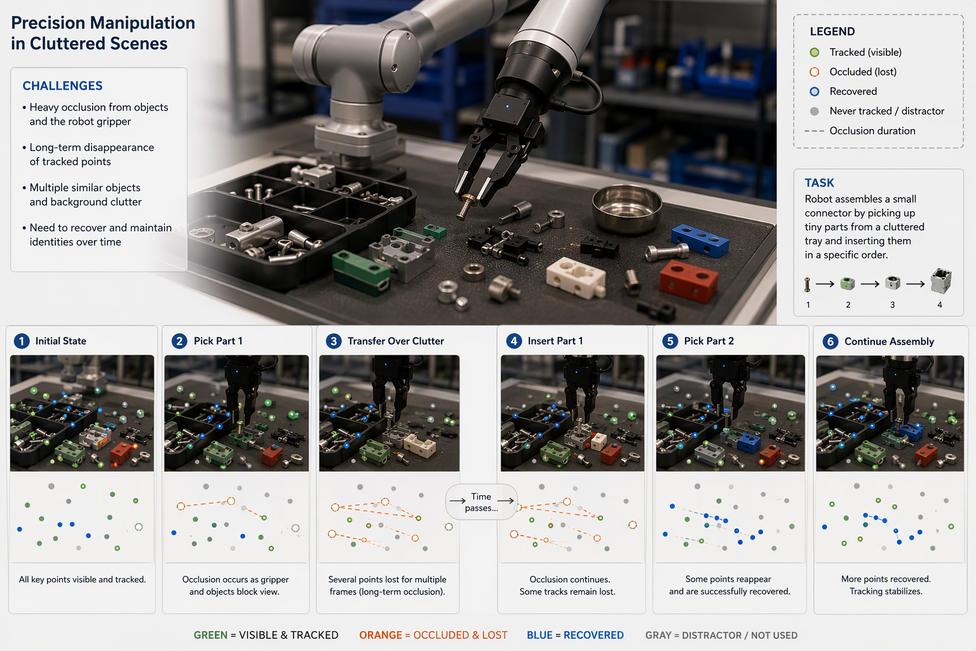
- Generate more specialized synthetic data reflecting the precision tasks such as pipetting.
- Enhance algorithms for long-term occlusion recovery and multi-object tracking.
- Further validate tracking improvements in real robotic deployments.
Conclusion
RoboTrack represents a significant step forward in improving robotic perception through advanced point tracking tailored for real-world manipulation tasks. By combining a rigorous benchmark with a vast, task-specific synthetic training set, AI2 has highlighted the limitations of existing trackers and provided practical models that enhance tracking accuracy.
These improvements have been empirically validated in complex scenarios such as wet-lab pipetting, demonstrating that precise point tracking can dramatically increase robotic task success rates over traditional perception methods.
As robotics move toward more intricate and dynamic applications, tools like RoboTrack will be essential for enabling robots to perceive and interact with their environments reliably and accurately.