

Exploring Simon Willison’s Weblog: Innovations in Web Technologies and AI
Discover Simon Willison’s influential weblog featuring groundbreaking projects like Datasette Lite, innovations in AI-assisted programming, and insights into emerging technologies such as WebAssembly and service workers.
On this page
Introduction to Simon Willison and His Weblog
Simon Willison is a prominent figure in the open-source and Python community, best known as the co-creator of Django and the driving force behind innovative projects like Datasette. His weblog serves as a rich source of technical insights, reflections on AI, and explorations into web technologies. With a unique blend of practical development tools and forward-thinking experimentation, Simon Willison's blog embodies a hands-on approach to modern web development and AI integration.
Key Themes in Simon Willison’s Weblog
The weblog covers multiple technologies and practices including data publication tools, server-side web applications, AI-assisted programming, and decentralized databases. It is a platform where concepts like AI, generative AI, WebAssembly, service workers, and lightweight Python applications converge.
Datasette and Datasette Lite: Revolutionizing Data Exploration
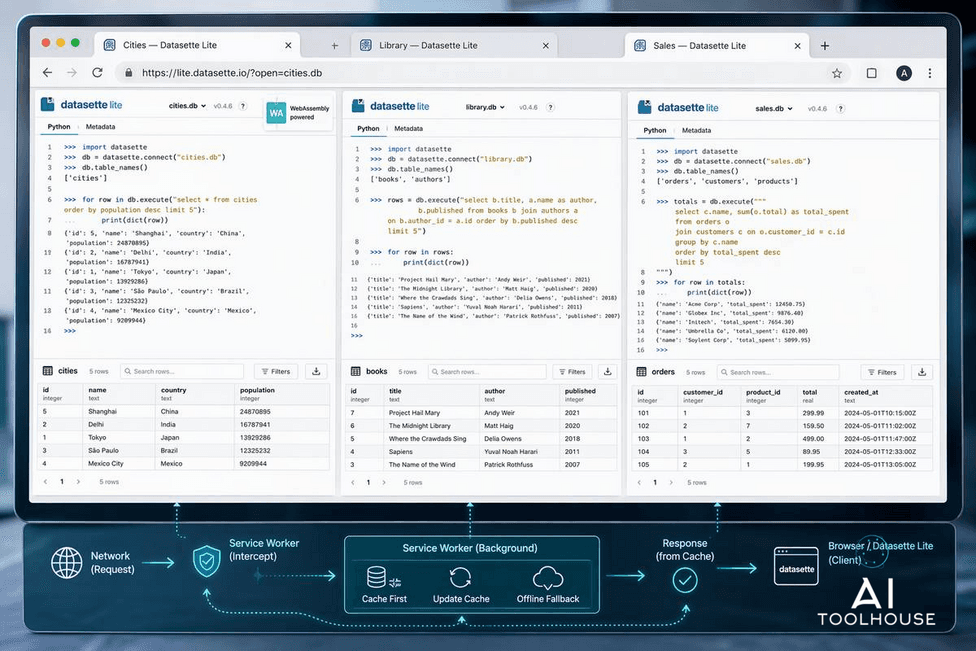
At the heart of Simon’s recent work is Datasette, an open-source tool designed to publish and browse structured data like SQLite databases. Datasette Lite takes this innovation further by enabling the entire server-side Datasette Python application to run within a browser using WebAssembly and Pyodide.
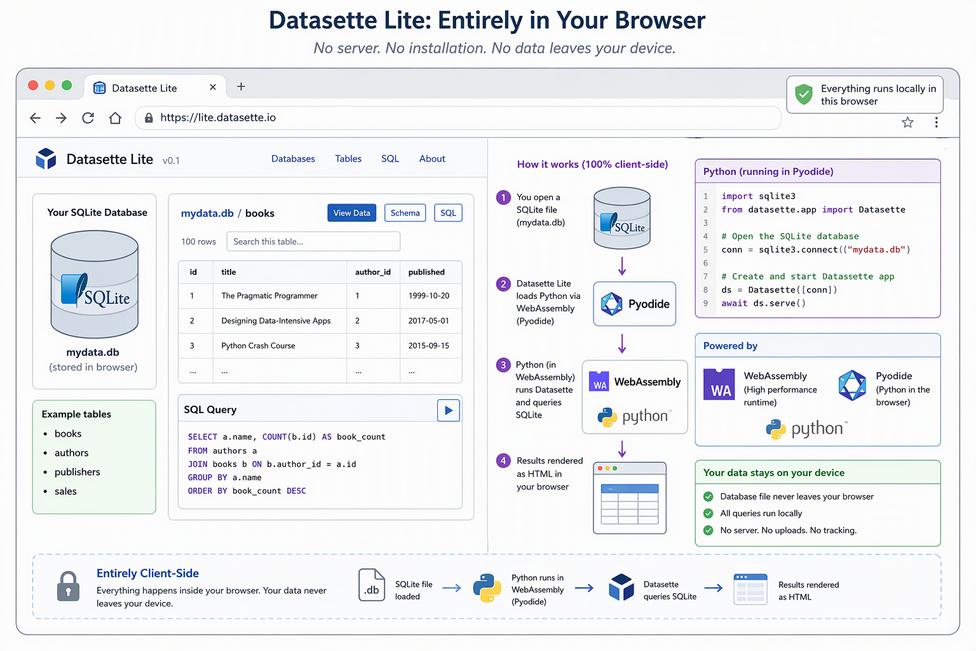
This breakthrough allows developers and data scientists to:
- Load any SQLite database, JSON, CSV file, or SQL script directly in the browser.
- Select different versions of Datasette and SQLite dynamically.
- Install additional plugins on-demand to extend functionality.
The technology relies on service workers which intercept HTTP requests, allowing the Datasette Lite app to serve resources entirely client-side. This architecture supports multiple concurrent sessions, isolating instances for independent tabs.
AI-Assisted Programming and Vibe Coding
Simon Willison explores the emerging practice of AI-assisted programming, with special attention to a method dubbed "vibe coding." Coined by Andrej Karpathy, vibe coding emphasizes a relaxed, interactive style of coding supported heavily by AI tools. Simon contrasts this with other forms of AI-assisted development, highlighting vibe coding’s potential to enhance creativity and rapid prototyping.
Embracing WebAssembly and Pyodide
WebAssembly (WASM) compilation and Pyodide integration empower Simon’s projects to run Python environments directly in browsers. This approach breaks traditional boundaries between client and server by:
- Allowing Python apps to run offline or without infrastructure.
- Enabling upgrades such as running different SQLite versions dynamically via Pyodide.
- Creating shareable, reproducible demo environments with minimal setup.
The weblog also documents new Python ecosystem potentials, referencing PEP 783, which facilitates publishing WebAssembly wheels on PyPI, further lowering barriers for client-side Python development.
Practical Implications and Differentiators
Simon Willison’s approach brings several advantages to developers and organizations:
- Accessibility: Running complex server-side apps like Datasette fully client-side democratizes data exploration and removes hosting dependencies.
- Flexibility: Support for multiple SQLite versions and plugins enables tailored demo experiences and debugging workflows.
- Interactivity: The service worker model ensures responsiveness equivalent to traditional server-hosted apps.
- Innovative Use of AI: By sharing his experiences with AI-assisted programming and vibe coding, Simon contributes to evolving best practices in the field.
Detailed Overview of Datasette Lite Architecture
The new version of Datasette Lite abandons innerHTML hacks for a clean architecture based on Service Workers and Web Workers:
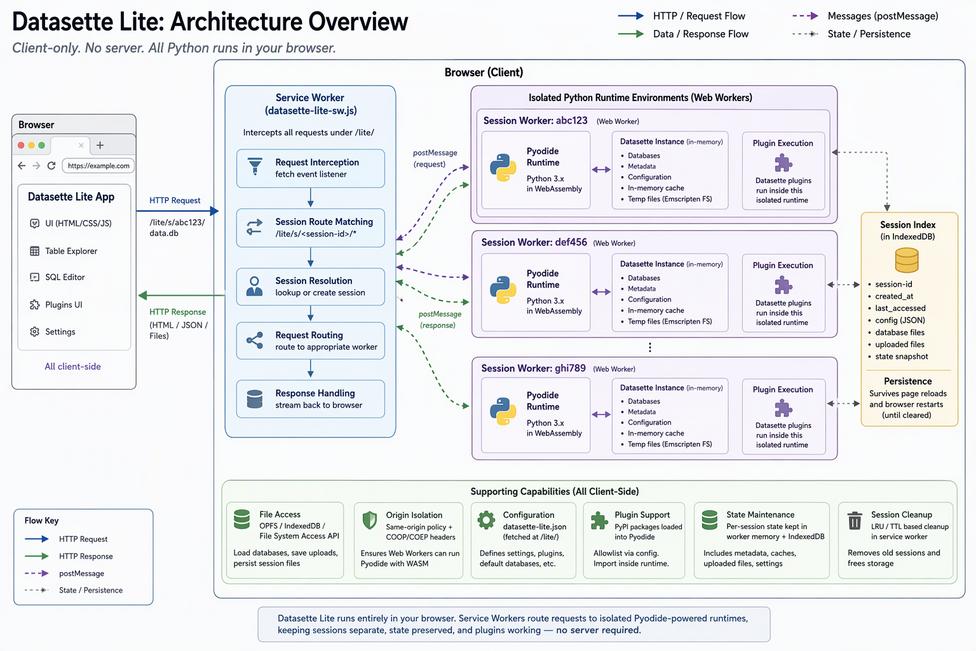
- The service worker intercepts URLs prefixed with a session-specific path.
- It routes requests to isolated Pyodide Python environments running in Web Workers.
- This preserves app state across requests and supports all advanced Datasette features, including JavaScript-enabled plugins.
This structure solves previous limitations around JavaScript execution and state persistence in a purely client-side context.
Comparison Table: Traditional Server Apps vs Datasette Lite
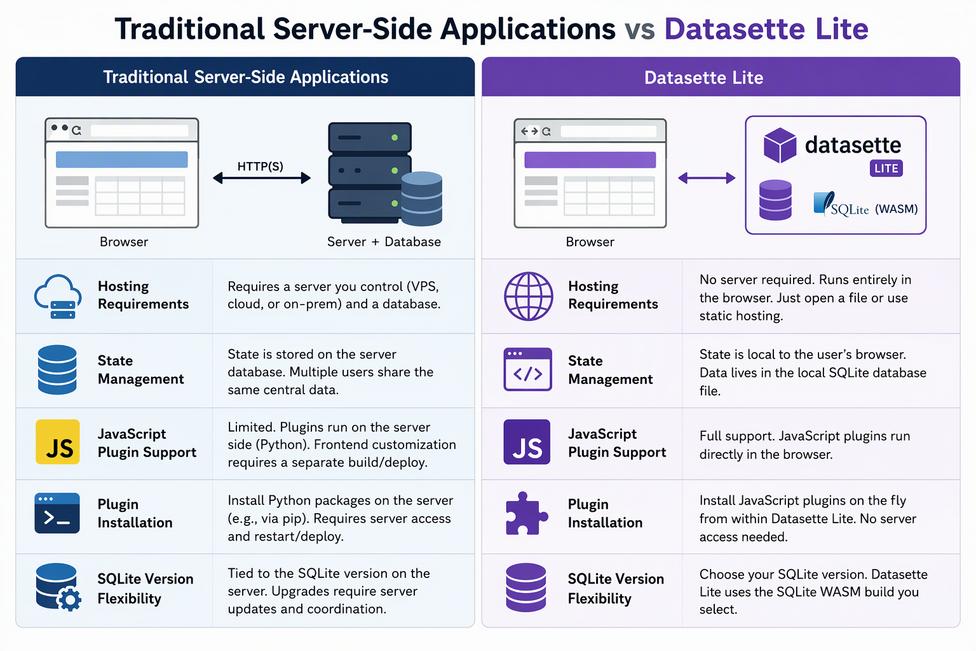
| Feature | Traditional Server-side App | Datasette Lite (Client-side via WASM) |
|---|---|---|
| Hosting Requirements | Requires dedicated server or cloud | Runs entirely in the browser, no hosting needed |
| State Management | Maintained on server | Maintained in Web Worker, isolated per tab |
| JavaScript Plugin Support | Fully supported | Fully supported with service workers |
| Plugin Installation | Needs server-side deployment | Dynamically installed from PyPI or URL |
| Version Flexibility (SQLite) | Depends on server environment | Choose SQLite version at runtime |
Simon Willison’s Influence in the AI and Developer Communities
Beyond his technical contributions, Simon Willison is an active commentator on AI trends, notably generative AI and agent-based architectures. His newsletter and social media presence provide ongoing analysis of AI tooling, productivity, and ethical considerations.
He advocates for transparent code, open-source collaboration, and integrating AI to enhance rather than replace human creativity.
Conclusion
Simon Willison’s weblog exemplifies the convergence of modern web technology, open-source innovation, and AI-assisted programming. His pioneering work with Datasette Lite demonstrates how complex server-side applications can operate seamlessly in-browser through WebAssembly and Pyodide, raising new possibilities for data accessibility and interactive demos.
By sharing insights on vibe coding and AI integration, Simon fosters a progressive dialogue around developer tooling and productivity enhancements. For developers, data professionals, and AI enthusiasts, his blog remains a valuable resource for exploring state-of-the-art technologies shaping the future of software development.