

Bridging Language and Knowledge: The Innovation of Indic Voice Agents with IBM's CUGA
Explore how IBM's open-source CUGA is powering multilingual Indic voice agents that provide accurate, sourced answers by bridging language gaps, transforming access to information for India's diverse linguistic population.
On this page
Introduction to Indic Voice Agents and the Need for Multilingual Support
India's linguistic diversity presents unique challenges for AI-driven information access. While vast knowledge resources are digitized primarily in English, many users think and communicate in regional languages like Hindi, Tamil, Telugu, Gujarati, Marathi, and others. This language gap limits the effectiveness of traditional text-based digital services for large segments of the population.
To address this, IBM Research has developed an Indic Voice Agent powered by CUGA — an open-source, configurable generalist agent harness.
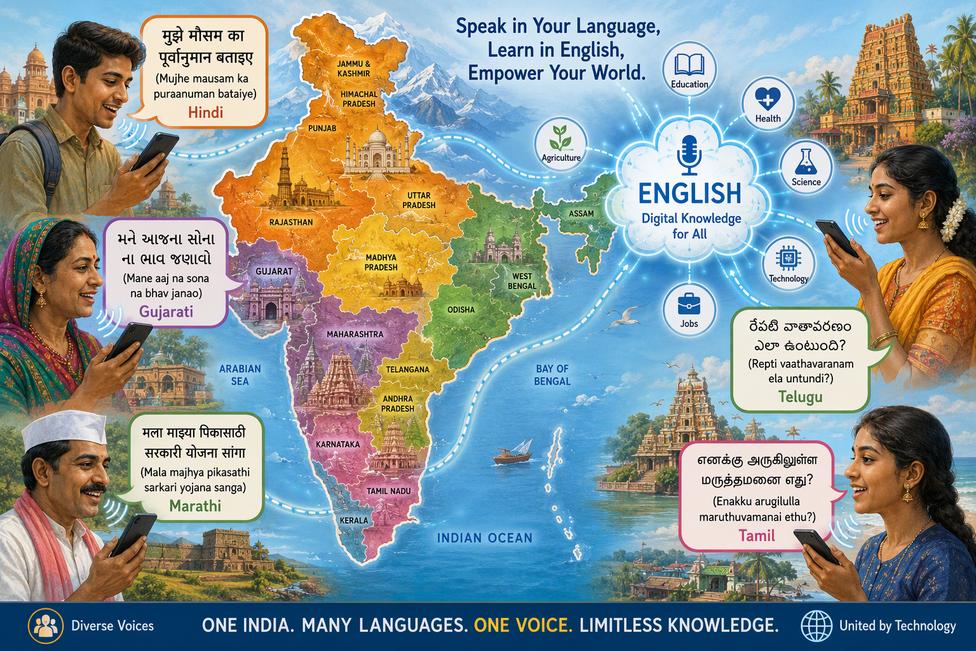
This voice agent aims to bridge language barriers by enabling people to interact in their native tongues with the backing of extensive English-language data, allowing intuitive, accessible voice-based queries and responses.
What is CUGA and How Does it Power Indic Voice Agents?
CUGA, short for ConfigUrable Generalist Agent, is IBM Research’s open-source agent framework designed to facilitate building adaptable AI agents. It manages complex tasks involved in agent deployment such as model integration, tool management, conversational state handling, and maintaining operational guardrails.
In the Indic Voice Agent implementation, CUGA acts as the core brain that processes text input and generates grounded answers based on retrieved knowledge. Voice capabilities are layered around CUGA with speech-to-text converting queries and text-to-speech rendering spoken responses. By decoupling voice processing from text-based reasoning, CUGA ensures flexibility to swap speech providers and models without re-engineering the entire system.
The Farming Use Case: Practical Application of the Indic Voice Agent
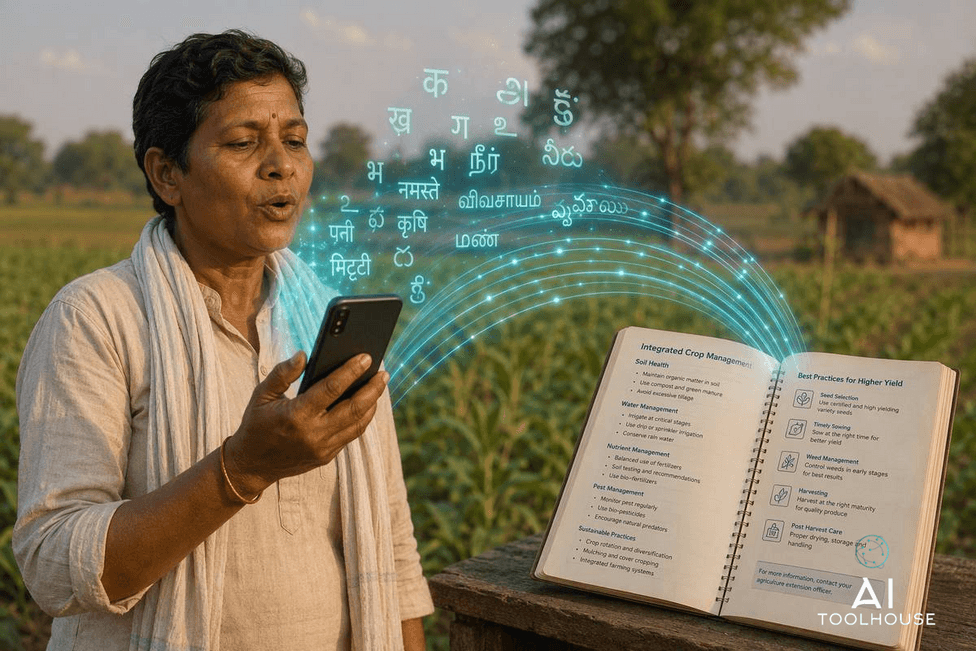
One powerful demonstration of CUGA’s Indic voice agent is in agriculture, a sector with millions of regional language speakers. Consider a farmer asking about crop quality or techniques in Hindi or Tamil. The system:
- Converts the spoken query to text.
- Searches relevant English-language documents (e.g., a 154-page agricultural handbook) for authoritative answers.
- Replies in the user’s original language, spoken aloud, while citing document sources for transparency.
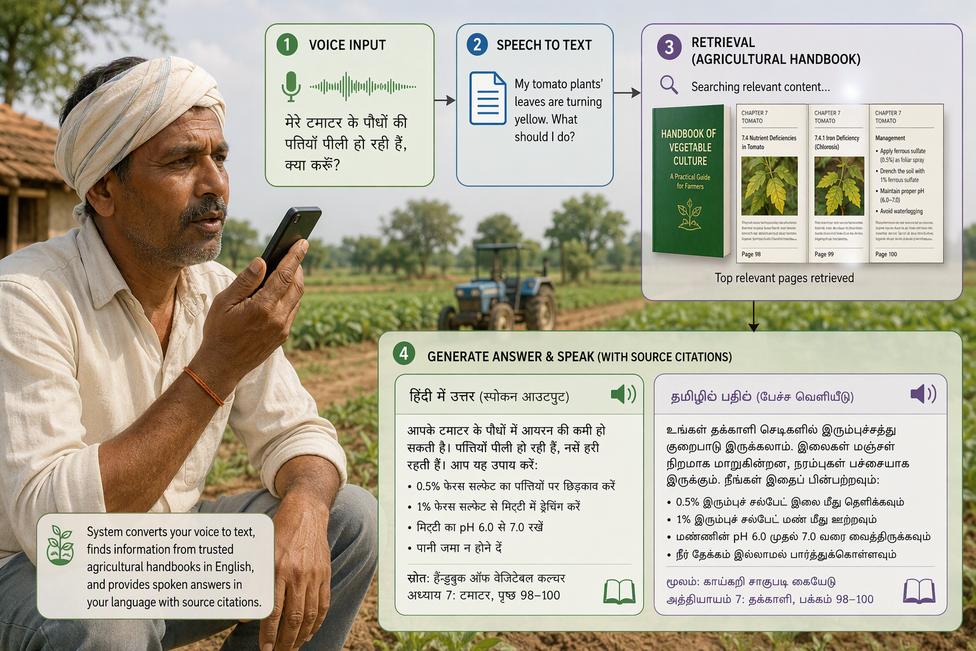
This use case highlights the agent’s capability to provide specific, grounded, and verifiable answers that maintain topical focus by politely steering off-topic queries back to agriculture, preventing misinformation.
Overcoming the Challenge of Cross-Lingual Retrieval
A key technical hurdle in this project was enabling cross-lingual retrieval — matching questions in Indic languages to English source documents. Traditional embedding models were English-centric, causing retrieval to return irrelevant or empty results when processing native language queries.
The breakthrough was using a multilingual embedding model (intfloat/multilingual-e5-large) that places semantically similar content from different languages into a shared vector space.
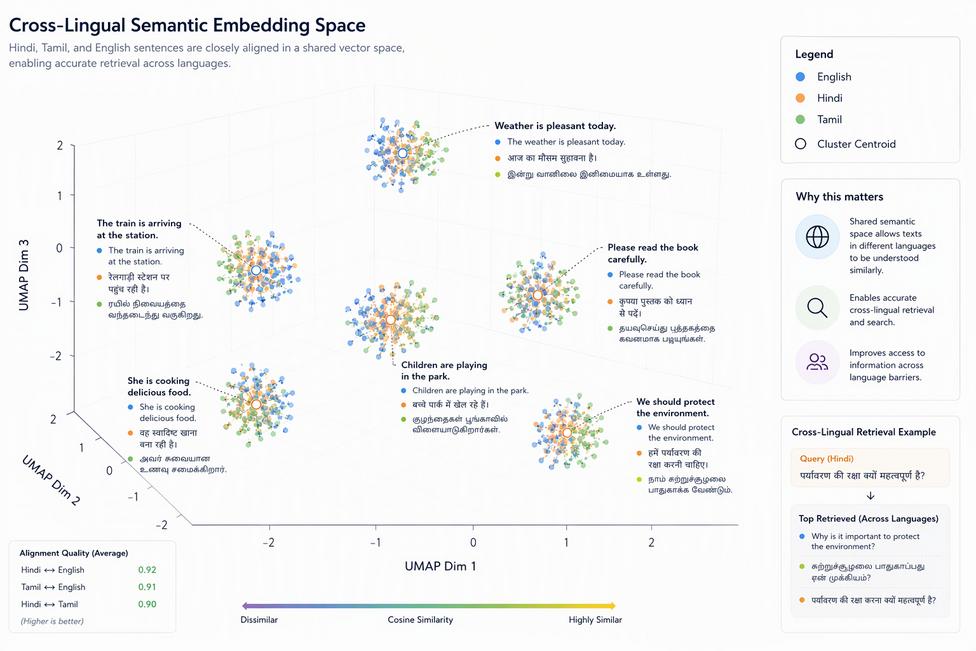
This alignment ensures a Hindi or Tamil question effectively retrieves the corresponding English knowledge passage, enabling accurate grounded responses from a single English text corpus without needing translated copies.
Voice Interface Flexibility and Deployment Considerations
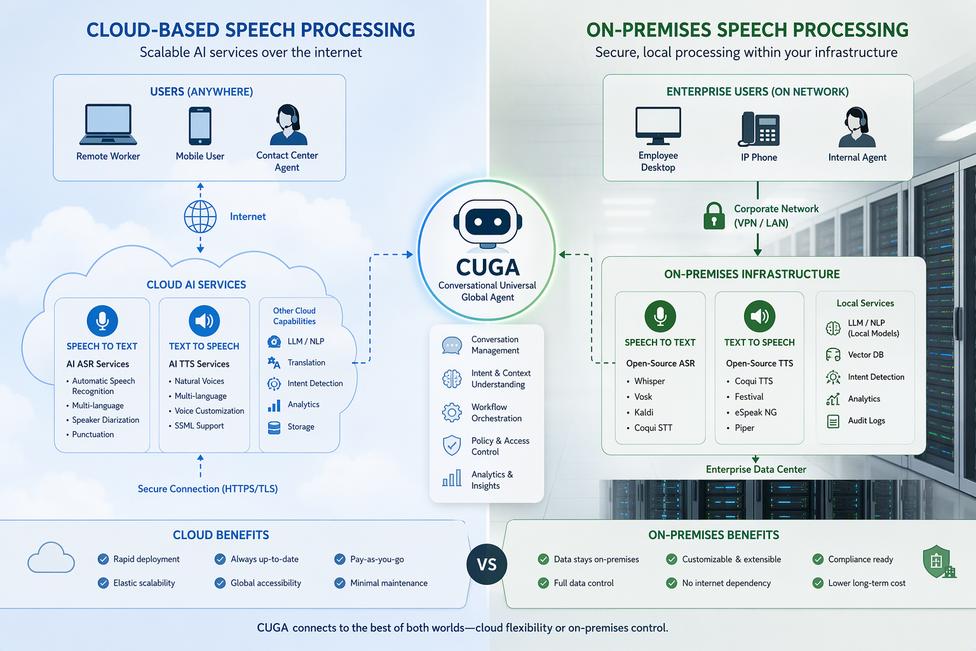
CUGA’s architecture allows integration with multiple speech service providers:
- Cloud-based APIs like Sarvam AI directly accessed in-browser.
- Open-source models like SraVaani for speech-to-text and Svara for text-to-speech that can run locally for data sovereignty.
This flexibility underpins diverse deployment options — from cloud for performance to on-premises for privacy and compliance, vital for enterprise or government applications.
Enhancing Usability and Trust
Several thoughtful design decisions enhance the user experience and trustworthiness of the Indic Voice Agent:
- Responses are crafted specifically "for the ear," avoiding formatting such as markdown or bracketed translations that do not translate well to speech.
- Simple guardrails detect off-topic queries early, flagging and redirecting them politely without additional model calls to maintain speed.
- Every answer is grounded on retrieved passages with sources presented, enabling users to verify information.
- Sensitive keys remain client-side when using cloud speech APIs, improving security.
Scaling Beyond Agriculture: The Vision for Bharat Core
While agriculture is an impactful starting point, the approach is domain-agnostic. By swapping the knowledge base, the agent can support diverse fields like healthcare, legal aid, and government schemes—all within India's multifaceted language context.
This agent framework is closely tied to IBM’s Bharat Core, an optimized AI stack built for India's unique ecosystem emphasizing local infrastructure, data sovereignty, and multilingual AI workloads. Combining CUGA with Bharat Core’s fine-tuned models and secure connectors prioritizes compliance and scalability for large-scale Indian vernacular AI solutions.
Comparing CUGA's Indic Voice Agent with Traditional Approaches
| Feature | CUGA Indic Voice Agent | Traditional Voice Assistants |
|---|---|---|
| Multilingual Retrieval | Uses advanced multilingual embeddings | Often limited to single dominant language |
| Knowledge Grounding | Answers grounded in trusted documents | Often relies on web search or general LLMs |
| Language Adaptability | Supports multiple Indic languages seamlessly | May require language-specific models or scripts |
| Deployment Flexibility | Cloud or on-premises speech integration | Usually cloud-dependent |
| Transparency | Shows source documents and citations | Rarely provides verifiable sources |
Practical Implications for Developers and Enterprises
Developers can leverage CUGA’s open-source framework and modular design to build voice-first multilingual applications tailored to specific regional needs in India. Enterprises benefit from the ability to integrate sovereign AI components respecting data privacy and compliance while delivering inclusive digital experiences.
Conclusion
IBM’s Indic Voice Agent, powered by the open-source CUGA harness, exemplifies a significant stride toward democratizing AI access for India’s linguistically diverse population. By innovatively combining multilingual embeddings for precise cross-lingual retrieval with flexible voice interface integrations, it provides users a natural, voice-first way to access complex knowledge bases. Its transparent, source-grounded answers foster trust, while its modular and secure deployment options meet enterprise demands.
This development not only transforms how rural and vernacular language speakers interact with digital information but sets a scalable blueprint for building responsible, inclusive AI agents globally. The synergy with Bharat Core further anchors its future as a foundational technology in India’s AI ecosystem, enabling sovereign, multilingual solutions at scale across domains far beyond agriculture.
The Indic Voice Agent with CUGA is thus a powerful example of how configurable, open AI agents can create meaningful, trustworthy user experiences that honor local linguistic and privacy needs, pointing the way to a truly inclusive AI-powered future.