

Visit Website
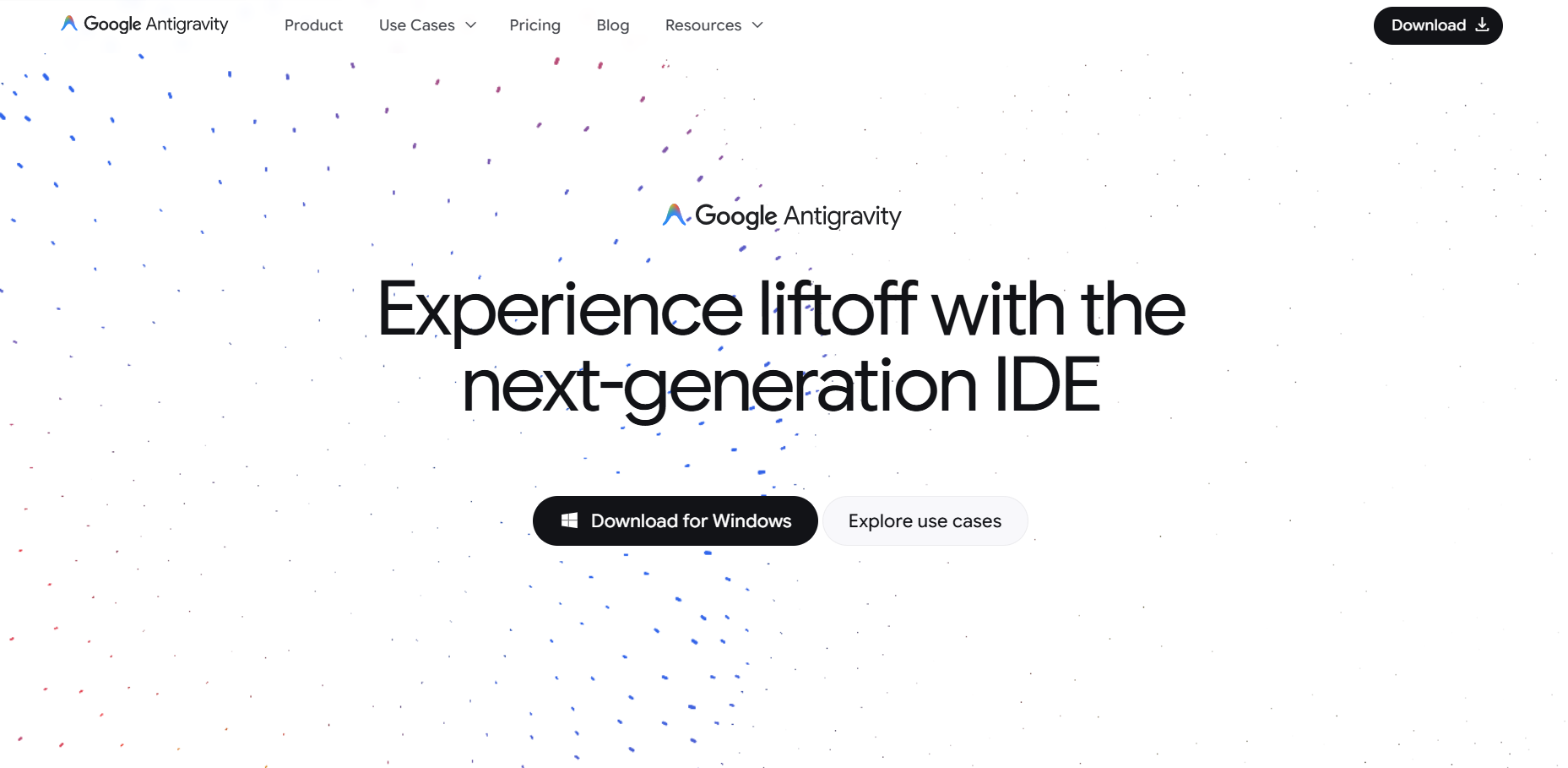
Google Antigravity is an AI-powered, agent-first Integrated Development Environment (IDE) released by Google in late 2025 to revolutionize software development.
What is Google Antigravity?
Google Antigravity is an advanced AI-powered, agent-first Integrated Development Environment (IDE) designed to redefine how software is built in the era of autonomous AI. Developed by Google and based on a modified Visual Studio Code architecture, it enables developers to delegate complex, end-to-end coding workflows to intelligent AI agents. Positioned at the intersection of AI-driven software development and autonomous systems, Antigravity acts as a mission control hub where agents can plan, write, test, and optimize code with minimal human intervention.
Unlike traditional coding assistants, Google Antigravity is built for the "agentic" paradigm, where multiple AI agents operate in parallel to execute tasks in the background. Powered by advanced models like Gemini 3.1 Pro and Flash, along with support for Claude and open-source models, it empowers developers to accelerate development cycles, reduce manual effort, and focus on higher-level problem solving. It is quickly emerging as one of the most innovative AI coding environments shaping the future of software engineering.
Key Features
- Agentic Development Environment: Enables autonomous AI agents to handle complete coding workflows including planning, file creation, debugging, and optimization.
- Agent Manager Interface: Provides a centralized dashboard to monitor, control, and manage multiple parallel AI agents working on different tasks.
- Integrated Code Editor: Combines traditional coding capabilities with AI-driven automation for seamless human and agent collaboration.
- Built-in Browser & Testing Agent: Automatically runs, tests, and validates code locally, ensuring faster debugging and verification cycles.
- Multi-Model AI Support: Integrates with Gemini 3.1 Pro/Flash, Claude Sonnet and Opus, and open-source models like GPT-OSS-120B for flexible AI workflows.
- Context-Aware Learning System: Learns from previous interactions, codebases, and workflows to build a reusable knowledge base for future tasks.
- Cross-Platform Compatibility: Runs locally on Windows, macOS, and Linux environments for secure and flexible development.
Pros
- End-to-end automation: Handles complete development workflows, reducing manual coding effort significantly.
- Parallel task execution: Multiple agents can work simultaneously, accelerating development timelines.
- Flexible AI ecosystem: Supports multiple AI models, allowing developers to choose the best model for specific tasks.
- Improved productivity: Enables developers to focus on architecture and strategy rather than repetitive coding tasks.
- Local execution: Enhances data security by running workflows on local machines.
Cons
- Early-stage platform: Still in preview phase, which may include bugs or incomplete features.
- Learning curve: Developers may need time to adapt to agent-based workflows.
- Resource intensive: Running multiple AI agents locally may require high computational resources.
- Limited availability: Access may be restricted during early rollout phases.
Use Cases
- Software Developers: Automate coding, debugging, and testing workflows using autonomous agents.
- Engineering Teams: Manage parallel development tasks and improve team productivity through AI orchestration.
- Startups: Accelerate product development cycles with minimal engineering overhead.
- AI Engineers: Experiment with multi-agent systems and advanced AI-driven coding environments.
- Enterprise Development: Streamline large-scale codebases and complex system architectures with agent-based automation.
Pricing
- Free Preview: Google Antigravity is currently available as a free preview during its early release phase.
- Future Pricing: Pricing models may evolve based on usage, model access, and enterprise requirements.
Note: Pricing and availability may change. Visit official Google resources for the latest updates.
Who is Google Antigravity For?
- Developers looking to automate complex coding tasks with AI agents
- Engineering teams managing multi-component systems and parallel workflows
- Startups and product builders aiming to reduce development time and costs
- AI researchers exploring agent-based programming environments
- Enterprises seeking scalable, AI-driven development infrastructure
What Makes Google Antigravity Unique?
Google Antigravity is more than just another AI coding assistant—it represents a fundamental shift toward agent-first software development. Its ability to orchestrate multiple autonomous agents that can independently plan, execute, and validate tasks sets it apart from traditional IDEs and copilots. Unlike tools that rely on human prompts for every action, Antigravity enables continuous, background execution of complex workflows, making it a true mission control system for modern software engineering.
With deep integration of advanced AI models, a dedicated agent management system, and built-in testing capabilities, Antigravity delivers a unified environment where development is faster, smarter, and more scalable. Its focus on autonomy, context awareness, and parallel execution positions it as a next-generation platform in the rapidly evolving AI development ecosystem.
Conclusion
Google Antigravity is redefining how developers interact with code by introducing a fully agentic approach to software development. By combining powerful AI models, autonomous task execution, and a familiar IDE environment, it enables faster development, better code quality, and more efficient workflows. As the software industry moves toward AI-driven automation, tools like Antigravity are set to play a central role in shaping the future of programming.
People Also Viewed


Get Featured! 🚀
Feature your AI brand at the top of our homepage for 7 days! Exclusive sponsorship for AI tools, platforms, and applications.
Promote Google Antigravity